

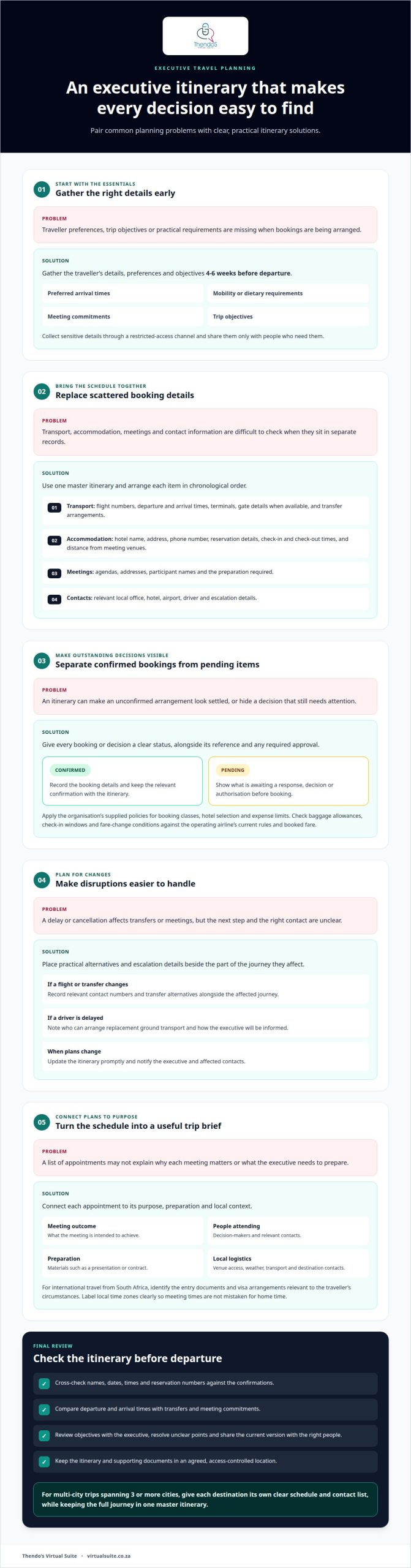
The most useful executive itinerary is not necessarily the longest, but the one that makes every decision easy to find. An executive travel itinerary planning checklist should bring transport, accommodation, meetings, contacts and contingency details together in chronological order. It should also distinguish confirmed arrangements from pending items, so the traveller can see at a glance what is settled.
It’s understandable to expect a polished itinerary to contain every booking detail, yet accuracy depends on how information is gathered, organised and updated. This guide explains what to include, how a concise trip brief can capture objectives and local logistics, and which template tools can keep records consistent across a South African or international trip. You’ll also see how to handle changes clearly, without turning the itinerary into a crowded document.
Key Takeaways
- Bring transport, accommodation, meetings and backup arrangements into one chronological itinerary, with confirmed and pending details clearly distinguished.
- Build a concise trip brief that connects the executive’s objectives with schedules, key contacts and local logistics.
- Use a consistent template suited to the trip, then keep bookings, confirmations and changes aligned in one place.
- Structured virtual assistant support can help keep travel details organised when coordinating arrangements becomes part of a wider operational workload.
What should an executive travel itinerary template include?
A professional planner gathers the traveller’s details, preferences and trip objectives 4-6 weeks before departure. This gives time to align flight times, meeting commitments, preferred arrival times and any mobility or dietary requirements. Sensitive information, such as passport details and private meeting locations, should be collected through a restricted-access channel and shared only with people who need it.
To build the itinerary, gather flight schedules, hotel reservations, meeting agendas and contact details, then arrange each item chronologically. Include flight numbers, departure and arrival times, terminals, gate details when available, transfer arrangements, meeting addresses and participants’ names. For each hotel, record its name, address, phone number, reservation details, check-in and check-out times, and distance from meeting venues. A suitable location, reliable connectivity and the traveller’s stated preferences can help guide the accommodation choice.
Corporate policies guide booking classes, hotel selection and expense limits. Apply the policy details supplied by the organisation, record any approval requirements and flag arrangements that need authorisation before booking. Baggage allowances, check-in windows and fare-change conditions vary by carrier, route and ticket type, so check the operating airline’s current rules against the booked fare.
- Record confirmed bookings and pending items separately. This makes outstanding decisions visible without confusing them with settled arrangements.
- Add escalation contacts and contingency details. A delay or cancellation is easier to manage when transfer alternatives and relevant contact numbers appear beside the affected journey.
- Include essential documents and local timing assumptions. Flight tickets, hotel confirmations, meeting agendas and directions help keep business travel logistics in one reference.
A detailed itinerary reduces avoidable uncertainty by setting out flights, transport, accommodation and meetings in a clear sequence, with practical next steps if plans change.
Trip briefs covering schedules, contacts, objectives, and local logistics
A useful trip brief connects each appointment to the executive’s reason for travelling. An executive travel itinerary planning checklist can record the intended meeting outcome, decision-makers attending and preparation needed, such as a presentation or contract. This helps distinguish essential commitments from optional events and organise the day around its priorities. For a conference, the brief can also track sessions, social events requiring an RSVP and prospective contacts.
Local conditions deserve their own planning notes. A public event near the destination may affect access to a venue, while weather can influence clothing and transport choices. Add local office contacts, hotel details, airport and driver numbers, and the person responsible for escalation. For travel from South Africa, identify the destination-specific entry documents and visa arrangements relevant to the traveller’s circumstances.
- Keep emergency details accessible. Record an appropriate emergency contact and the relevant local contact for the destination.
- Connect alternatives to affected plans. If a driver is delayed, note who can arrange replacement ground transport and how the executive will be informed.
- Maintain a usable reference. Keep the planning checklist with the meeting agenda and essential travel documents, using suitable access controls for sensitive information.
Before departure, review the brief with the executive, resolve unclear objectives and ensure the right people have the current version. This makes the document useful for decision-making, not merely a list of appointments.
Executive assistant itinerary template tools
A consistent template gives an executive assistant a dependable structure for each booking while leaving room for trip-specific details. Use one master itinerary to organise flights, accommodation, ground transport, meetings, contacts and supporting documents. Separate fields for booking references and confirmation status make it easy to distinguish settled arrangements from items awaiting a response.
For domestic travel, a booking sheet can bring flight, train, car and hotel reservations together with their confirmations. A multi-city template is useful for trips spanning 3 or more cities, as it gives each destination a clear schedule and contact list. The assistant adapts the layout to the itinerary rather than forcing every trip into identical logistics.
Planning tools are most useful when they support a reliable process. Collect the source details, enter them into the template, then check names, dates, times and reservation numbers against the relevant confirmations. A final review can compare departure and arrival times with transfers and meeting commitments. For international trips, label local time zones clearly so meeting times are not mistaken for the traveller’s home time.
- Use one source of truth. Keep the current itinerary in an agreed, access-controlled location, with documents organised alongside it.
- Record changes immediately. If a flight or meeting changes, update the itinerary and notify the executive and affected contacts.
- Prepare for disruption. Add relevant escalation contacts and practical alternatives beside the part of the schedule they affect.
The value comes from a repeatable method, not a complicated tool: one clear template, careful cross-checking and prompt updates. For dependable virtual assistant support with travel coordination, consider structured assistance that keeps details aligned.
Thendo’s Virtual Suite
Thendo’s Virtual Suite provides virtual assistant and structured operational support to help organise executive travel details. This can be useful when arranging flights, meetings and ground transport competes with daily responsibilities, or when updates are spread across emails, calendars and booking documents. Support can include organising supplied information, maintaining itinerary records and keeping relevant details aligned as plans change.
For an executive travelling domestically or internationally from South Africa, a consistent process keeps trip objectives, schedules and arrangements together. The right level of support depends on the travel requirements and coordination involved. If travel planning is becoming difficult to manage alongside other priorities, contact Thendo’s Virtual Suite to discuss the support you need.
Make each journey easier to coordinate
A well-maintained executive travel itinerary planning checklist can serve as a practical reference for future trips, not just a schedule for one departure. After the executive returns, note which arrangements worked well and where coordination could be clearer. This feedback can help refine the planning process around the traveller’s preferences and the organisation’s routines.
When travel arrangements compete with essential day-to-day work, dependable administrative support can help keep coordination organised. Thendo’s Virtual Suite offers virtual assistant support and structured operational support for business needs. Discuss the support that would help your travel planning run more smoothly with Contact Thendo’s Virtual Suite.
Frequently Asked Questions
How does a professional assistant check that every detail in an executive itinerary is accurate?
Check itinerary entries against original booking confirmations and meeting invitations rather than relying on copied notes alone. Review whether dates, time zones and transfer timings align across the schedule. A final version check helps ensure the executive and relevant contacts are working from the same current document.
What if there are changes in the itinerary?
Update the affected itinerary entries and communicate the change to the executive and relevant people. If a meeting moves, for example, review its effect on the next transfer and appointment, then share the revised schedule with those involved. Clear version labelling helps prevent an earlier copy from being mistaken for the latest plan.
Why is this important?
A dependable itinerary helps an executive make informed decisions without piecing details together from separate messages. It also gives colleagues a shared reference if plans shift. For example, knowing which meeting depends on a particular arrival time makes it easier to identify what needs attention first when travel is disrupted.
What information should a client provide before an executive business trip is planned?
Provide the trip’s purpose, destination, meeting commitments, preferred travel arrangements and any relevant organisational booking policies. The planner also needs the traveller’s correct name as shown on travel documents, suitable contact details, approval requirements and any practical preferences affecting the schedule. Share sensitive details through an appropriate secure channel, not a broadly accessible document.
How does a professional assistant coordinate flights, airport transfers and meeting schedules?
Treat the journey as one connected schedule by matching flight arrival details with the transfer plan and meeting start times. Confirm arrangements using the relevant booking records and contacts, then account for travel between the airport, accommodation and meeting venues. If a flight changes, review which onward arrangements need updating.

Article by
Thendo Sadiki
CEO of Virtual Suite