

A business can have capable people and still lose time when tasks lack clear ownership or decisions have no agreed process. Structured operational support aligns activities, responsibilities, resources and working practices so everyday work contributes to business goals.
When a team is busy, it is natural to focus on getting the work done. But the structure behind the work affects how tasks move, who makes decisions and where resources go. The right arrangement depends on the organisation’s goals, size, operational complexity and culture, as well as changes such as growth or new services.
This article explains how operational structures shape activities, resource use and responsibilities, and what to consider when choosing a suitable support structure. It also shows how clear workflows and ownership can reduce duplicated effort and help teams work together.
Key Takeaways
- Clarify who owns each activity, decision and resource so work can move forward with less duplication.
- Choose a structure that fits your business goals, size, complexity and working culture, then revisit it as these needs change.
- Assess how workflows, communication and responsibilities connect before deciding where operational support will be most useful.
- When day-to-day coordination becomes difficult to manage, consider how structured support, CRM management or project management could bring greater clarity.
How operational structures define activities, resource use, and rules
An operational structure connects activities, decision-making and resource use with a business’s strategy. Clear working relationships define responsibilities, while workflows show how tasks move between people.
For example, a functional organisational structure groups people by expertise, while a matrix structure gives some people reporting relationships with multiple managers. The right model depends on the business’s goals and complexity.
Structured packages and ad hoc support
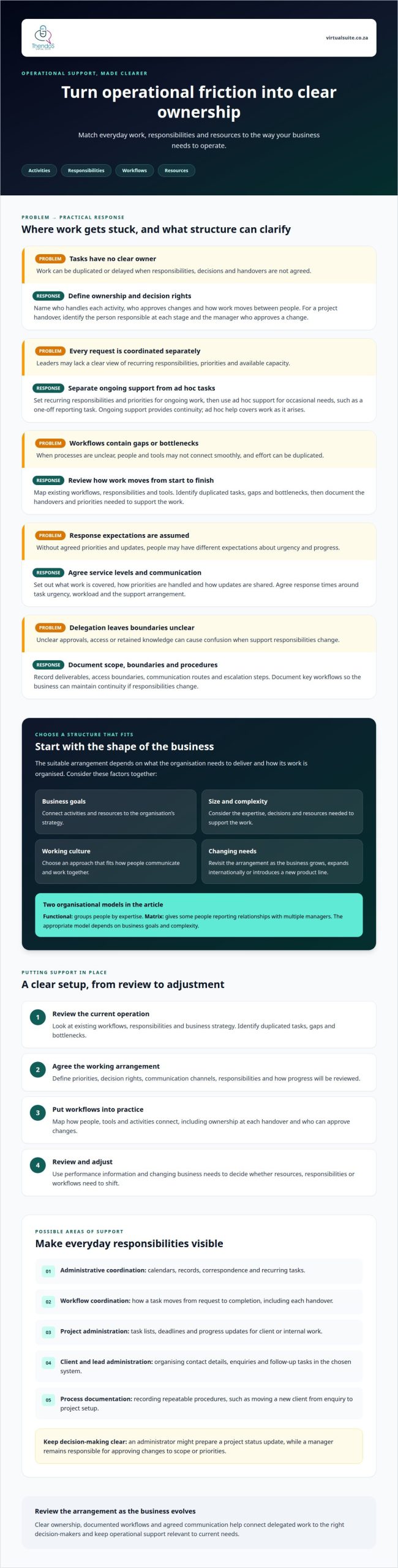
Structured operational support defines recurring responsibilities, workflows and priorities. Ad hoc support, by contrast, addresses tasks as they arise. The distinction matters when leaders need a clear view of ownership and capacity instead of coordinating every request separately.
For example, a consultancy might arrange ongoing support for client administration and project tracking, then request extra help with a one-off reporting task. Ongoing support provides continuity, while ad hoc help suits occasional needs.
Service levels and response times
Service levels set out what work is covered, how priorities are handled and how updates are shared. Response times should reflect task urgency, workload and the agreed support arrangement, rather than being assumed to follow one standard.
Businesses in South Africa can engage virtual assistants or operations professionals for administrative and workflow coordination. An analyst may help clarify task ownership, while leadership decides which work is critical and who can approve changes.
Setting up operational support
Setup begins with a review of existing workflows, responsibilities and business strategy. The provider can then identify duplicated tasks, gaps and bottlenecks, and map how activities, people and tools connect.
Next, the business and provider define priorities, decision rights, communication channels and how progress will be reviewed. A project workflow, for example, can name the person responsible for each handover and specify which manager approves a change.
Finally, the arrangement is put into practice and adjusted as the business evolves. Leaders can use performance information and changing trends to decide whether resources, responsibilities or workflows need to shift, keeping support relevant to current needs.
Factors affecting support structure
A suitable structure depends on business strategy, size, operational complexity and the work each function must deliver. Together, these factors determine the expertise, decision-making and resources needed to support the organisation’s vision.
Choosing an operational support provider
Choose a provider whose expertise and working approach fit the processes your business needs support with. The structure should suit your operations, not simply add another layer of coordination.
For a South African consultancy, for example, priorities might include consistent client administration and clear project handovers. Identify the tasks, expected outputs, access needs and reporting relationships before agreeing the scope. Ask how the provider will maintain alignment with your existing workflows and who will make decisions when priorities change. Clear answers help you assess whether the arrangement can deliver the support your function requires.
Risks and limitations
Operational support can create confusion when responsibilities, approvals or access boundaries are unclear. A director who delegates scheduling, for example, still needs agreed processes for urgent changes and sensitive records. Review ownership and communication as the business evolves.
For South African work involving personal information, the agreement should record each party’s responsibilities for access, confidentiality, storage, retention and secure deletion. Applicable compliance requirements depend on the information handled and the business activity. Set out the service scope, deliverables, communication routes and escalation process in writing, so everyone understands their role.
Relying on external support without retaining internal knowledge can also create problems. Document key workflows to support continuity if responsibilities change. Regular reviews help identify new needs, keep the arrangement aligned with the business’s goals and ensure it continues to serve its purpose.
Internal changes, such as expanding internationally or introducing a new product line, can require a different operational approach. The most suitable organisational model depends on the business’s needs and goals.
What services are included in structured operational support?
The scope depends on what a business needs to keep its daily work organised. A South African consultancy, for example, may need help coordinating client records, project updates and routine administration, while a growing agency may need clearer handovers between its sales and delivery teams.
Common areas of support can include:
- Administrative coordination: organising calendars, records, correspondence and recurring tasks so essential information is easier to manage.
- Workflow coordination: documenting how a task moves from request to completion, including who handles each handover.
- Project administration: maintaining task lists, deadlines and progress updates for a client project or internal initiative.
- Client and lead administration: keeping contact details, enquiries and follow-up tasks organised in the business’s chosen system.
- Process documentation: recording repeatable procedures, such as how a new client’s details move from initial enquiry to project setup.
These activities work best when their boundaries are clear. An administrator might prepare a project status update, while a manager remains responsible for approving changes to scope or priorities. This distinction connects delegated tasks to the right decision-maker.
Support can adapt as a business changes. A sole consultant may initially need calendar and client administration, then add project coordination as the workload grows. Set the scope according to actual processes, required expertise and available capacity, rather than adding tasks without clear ownership.
For a considered discussion about operational support for your business, connect the tasks causing the most friction with the support they require.
At an institutional scale, the United Nations Department of Operational Support provides logistics and ICT support from Global Services Centres, alongside administrative services from the Regional Service Centre Entebbe and Kuwait Joint Support Office.
Managed services delivery teams may use tiered Level 1-4 support for incident management and technical expertise. These examples show that structured operational support can encompass both administrative services and specialist technical assistance.
Thendo’s Virtual Suite: Structured operational support
Founders, professionals and growing businesses can review their operational support needs with Thendo’s Virtual Suite. When administration, client records or project coordination become difficult to manage alongside leadership responsibilities, identifying recurring tasks and clarifying priorities can help show where additional support may be useful.
Consider areas such as executive and administrative support, customer support, project coordination, finance and administrative support, or business tools and systems support. Discuss which of these areas may be relevant, rather than adding processes without purpose.
Start by identifying recurring tasks that take attention away from core responsibilities, or handovers and follow-ups that need greater consistency. This gives you a clear basis for discussing your operational needs with Thendo’s Virtual Suite.
Please contact Thendo’s Virtual Suite to discuss your operational support needs.
Give your operations a clear next direction
Well-designed systems give leaders more room to focus on work that moves the business forward. Treat structured operational support as an ongoing way to protect that focus, rather than a one-off response to pressure. As the arrangements take hold, leaders can give more attention to planning, relationships and decisions about the business’s direction.
Begin with a consultation to discuss the support that would make the greatest difference to your working day. Thendo’s Virtual Suite will help identify high-value tasks and shape a practical next step towards clearer operations.
If you’re ready to explore that next step, contact Thendo’s Virtual Suite. You can move forward at a pace that feels right for your business.
Frequently Asked Questions
What does structured operational support mean?
Structured operational support organises assistance around agreed business needs, responsibilities and recurring work. A consultancy might define how enquiries are recorded, assigned and followed up, giving each handover a clear owner. Consistent processes help teams avoid relying on memory or scattered messages.

Article by
Thendo Sadiki
CEO of Virtual Suite