

Founder overwhelm often stems from carrying too many operational decisions, administrative tasks and follow-ups alone. Practical support for overwhelmed founders means sharing that load through trusted support, clearer processes and thoughtful delegation, leaving founders more time for work that needs their judgement.
It’s understandable to feel that staying on top of everything is part of leading a business. But persistent pressure, disrupted sleep, irritability or difficulty making decisions can be signs that the way you work needs attention, not simply more effort.
This article explores why running a business can become difficult to manage, how peers and advisers can offer perspective, and which tasks may be suitable to delegate. It also explains how structured operational support can ease day-to-day pressure without adding unnecessary complexity.
Key Takeaways
- Notice when sleep, communication or decision-making starts to suffer, and treat these changes as signals to review how work is organised.
- Build a trusted network of peers and advisers who can offer perspective, accountability and a space to discuss the pressures of leadership.
- Start delegation with clear, lower-stakes tasks, sharing the context and preferences that help someone else handle them well.
- Look beyond personal workload to the processes behind recurring bottlenecks, including follow-ups, project coordination and administrative routines.
1. Building a founder support network
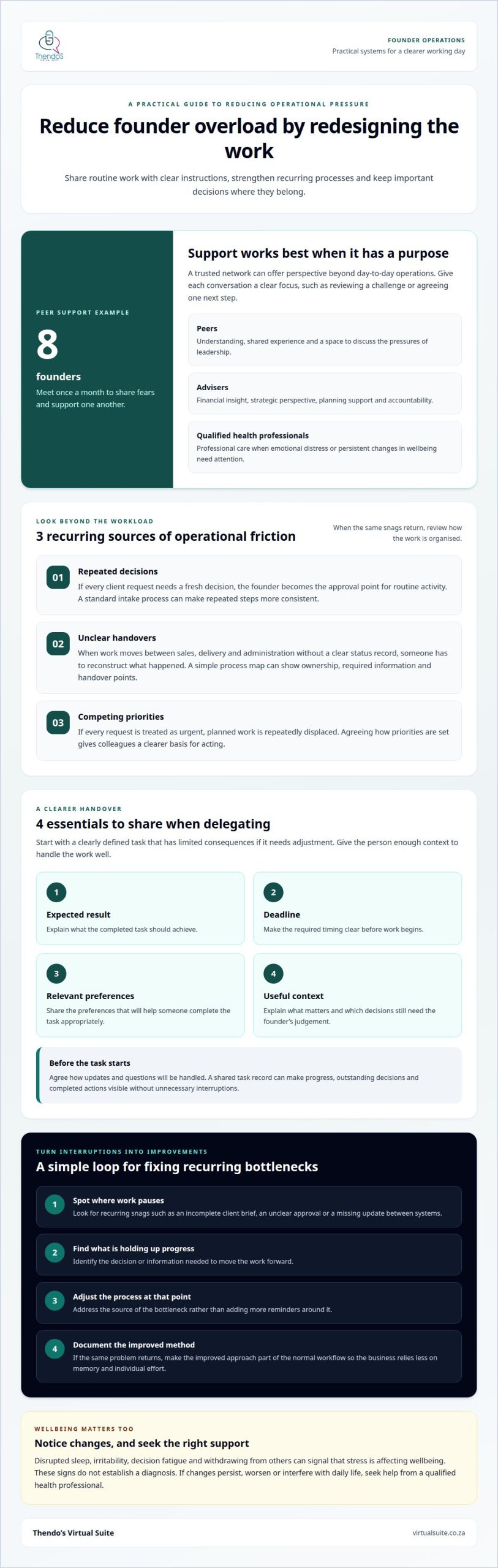
Leadership can feel isolating when every decision comes back to the founder. A startup network creates space to test ideas, discuss uncertainty and gain perspective beyond daily operations. For example, Pip Jamieson belongs to a group of eight founders who meet once a month to share fears and support one another. Regular peer meetings can make difficult conversations part of business life, rather than something postponed indefinitely.
Build a network around distinct needs. Peers can offer understanding, while external advisers may provide financial insight, strategic perspective, planning support and accountability. A founder facing unclear priorities could discuss strategy with an adviser, then use a peer group to reflect on the pressure behind those decisions. Give each conversation a clear purpose, such as reviewing a challenge or agreeing one next step.
In South Africa, support can include founder peer groups, business advisers and qualified mental health professionals. Choose the type that fits the need: business guidance for operational decisions, or professional care for emotional distress. This makes support for overwhelmed founders more practical than expecting one person to resolve every challenge.
Disrupted sleep, irritability, decision fatigue and withdrawing from others can signal that stress is affecting wellbeing. These signs don’t establish a diagnosis, but founders shouldn’t ignore persistent changes. Seek help from a qualified health professional if symptoms continue, worsen or interfere with daily life. A trusted colleague can help make that first conversation easier.
Before sharing personal or business challenges, consider confidentiality, conflicts of interest and what information is necessary. In a peer group, agree how private discussions will be handled; with an adviser, clarify the scope of the conversation. Share sensitive details selectively, especially when client, employee or financial information is involved. Clear boundaries help founders speak openly while protecting people and business interests.
2. Delegating and outsourcing work
A constant stream of small tasks can consume attention needed for leadership. Delegation can help when routine work repeatedly interrupts decisions, client conversations or focused planning. For example, an assistant can sort incoming messages, flag those requiring a decision and prepare draft replies to routine enquiries. The founder retains control over sensitive communication, while everyday correspondence follows a clearer process.
Meeting preparation is another practical opportunity to delegate. An assistant can gather background information, compile a briefing and organise material for a board presentation. For a project, they can track commitments and follow up on outstanding deliverables. These activities make ownership and next steps visible, helping prevent a missed handover from holding up progress.
Start with a clearly defined task that has limited consequences if it needs adjustment. Explain the expected result, deadline and relevant preferences. If an assistant is preparing a briefing, for instance, specify which decisions the meeting must support and what information matters. Context helps them respond sensibly when the situation differs from the usual routine.
Agree how updates and questions should be handled before work begins. A shared task record can show progress, outstanding decisions and completed actions without creating unnecessary interruptions. After the first handover, review the result together. Clarify any gaps in the instructions, then decide whether the task is ready to continue independently.
Expand responsibilities gradually as the working relationship develops. Keep decisions that require the founder’s judgement with the founder, and assign repeatable coordination work with clear boundaries. This creates a practical division of responsibility, rather than transferring tasks without the information needed to complete them well.
3. Structural causes of founder overwhelm
Some pressure comes from how work is designed, not simply how much work exists. If every client request requires a fresh decision, the founder becomes the approval point for routine activity. A service business, for example, may repeatedly ask what information to collect before starting work. A standard intake process turns that repeated judgement into a consistent step.
Unclear handovers create another source of friction. A task may move between sales, delivery and administration without a clear record of its status. The founder then has to reconstruct what happened before deciding what comes next. A simple process map can show who receives each request, what information they need and where responsibility changes.
Work can also accumulate when priorities aren’t clearly defined across the team. If every request is treated as urgent, planned work is repeatedly displaced. Agreeing how priorities are set and recording the reasons for changes gives colleagues a clearer basis for acting without seeking fresh approval each time.
Review the points where work regularly pauses: an incomplete client brief, an unclear approval or a missing update between systems. For each bottleneck, identify the decision or information holding up progress. Then adjust the process at that point, rather than adding more reminders around it.
A useful test is whether the same problem returns after it has been resolved. If it does, document the improved method and make it part of the normal workflow. This turns a recurring interruption into an operational lesson, helping the business rely less on memory and individual effort as activity grows.
Thendo’s Virtual Suite
Thendo’s Virtual Suite helps founders bring more structure to recurring operational demands. If routine administration, calendar commitments, client follow-ups or project coordination keep drawing attention away from leadership, practical support can give those tasks a clearer rhythm.
Virtual assistant support can help with day-to-day coordination, while structured operational support can address recurring workflow pressure. CRM Management and Project Coordination can also help organise client information and deliverables. The right focus depends on where work repeatedly stalls or becomes difficult to manage.
Consider seeking support when the same tasks keep accumulating, follow-ups are slipping or projects depend on your constant involvement. Book a consultation with Thendo’s Virtual Suite to discuss the operational pressures you’d like help addressing.
Make space for the leadership your business needs
Give your capacity the same attention as other business priorities. Set aside time to decide which responsibilities genuinely need your judgement, which can follow a clear process and where your attention is stretched too thin. This makes the next step a deliberate operating choice, rather than another urgent task added to an already full day.
Support for overwhelmed founders works best when it addresses the pressure behind the workload. Choose one change that would make your working week more manageable, then give it a clear owner and a practical starting point. You don’t need to redesign everything at once to create more room for thoughtful leadership.
If you’re ready to discuss what support could look like for your business, contact Thendo’s Virtual Suite. A considered next step can help you lead with greater clarity.
Frequently Asked Questions
Why do so many startup founders feel overwhelmed?
Founders often move between very different roles during the same working day. They may shift from answering a client to reviewing a supplier issue, then make a hiring or product decision without time to reset. Each role brings different information and consequences. This constant switching can make even a manageable workload feel fragmented and harder to approach thoughtfully.
How can founders reduce overwhelm without slowing business progress?
Break a large initiative into stages, each with a defined outcome and review point. For example, a service launch might begin with a small client group before wider promotion. This allows the founder to learn from early delivery, correct practical issues and continue with clearer priorities. Progress becomes a sequence of manageable decisions rather than one demanding, all-at-once commitment.
How does overwhelm affect business performance and financial decisions?
Pressure can narrow attention to immediate demands, leaving less room to assess the wider implications of a commitment. A brief decision record can help: note the purpose, expected benefit, key assumption and review point. For financial choices, this creates a reference for assessing whether the original reasoning still holds, rather than relying on memory or the urgency of the moment.
How does overwhelm affect people, leadership, and company culture?
Team members often take cues from how leaders respond to uncertainty. If a founder treats every setback as a crisis, colleagues may hide early concerns or avoid raising a different view. Leaders can set a healthier pattern by asking what is known, what remains uncertain and what action is needed next. This makes thoughtful discussion part of everyday work.
What practical steps can overwhelmed founders take to reduce workload and delegate effectively?
Review current commitments and decide which can stop, wait, remain with the founder or move to someone else. Before transferring work, clarify the recipient’s decision-making authority and when to escalate. Afterward, assess whether the founder has genuinely released the task or is still duplicating it through unnecessary checks. This helps delegation reduce workload in practice.

Article by
Thendo Sadiki
CEO of Virtual Suite