

What if business growth depended less on working longer and more on making room for the work only you can do? For a growing business, virtual assistant support can take recurring administration off your plate, giving you more time for clients, decisions and development. It’s reasonable to want practical help without losing oversight or adding unnecessary complexity.
This guide explains which administrative tasks are suitable to outsource, how the scope of support affects costs in South Africa, and how a virtual assistant can contribute to more organised operations as your business grows. You’ll also learn how to distinguish tasks that can be delegated from those that need your direct attention, and how consistent support can help keep schedules, records and client follow-ups in order. The aim is to help you consider the right kind of support for your business, with a clear view of what it can and cannot take off your hands.
Key Takeaways
- Identify routine administrative work that can be delegated, while keeping decisions requiring your expertise in your hands.
- Understand how the scope and type of support shape costs, and what to consider when planning a suitable arrangement.
- See how organised lead follow-ups, scheduling and project coordination can create more room to focus on business growth.
- Explore how Thendo’s Virtual Suite can provide virtual assistant and structured operational support as your business needs evolve.
1. Outsourcing administrative and non-core tasks
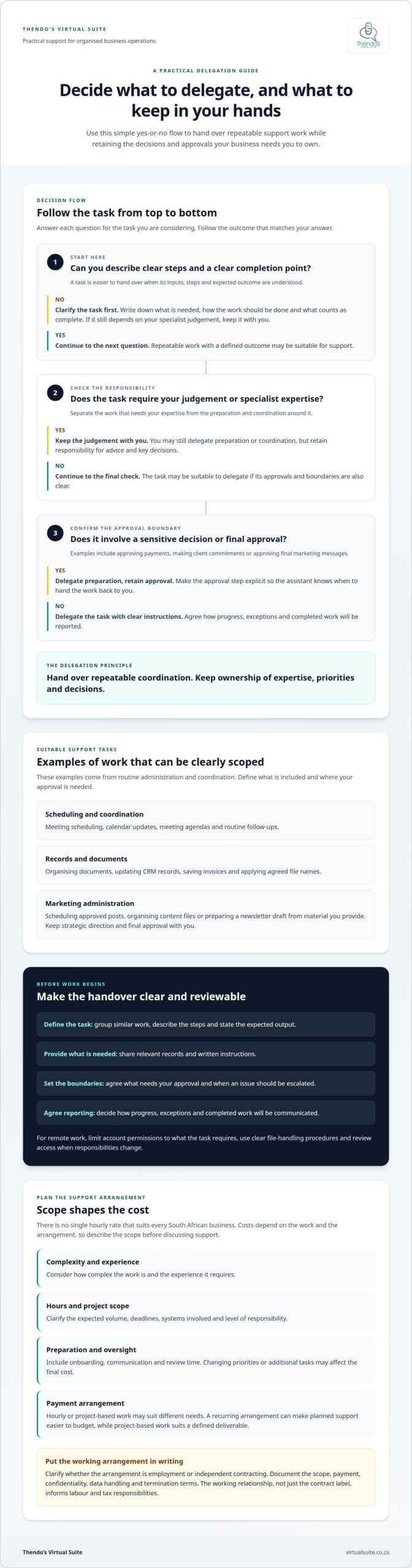
Administrative support works best when recurring tasks have clear steps and outcomes. For example, a consultant could delegate meeting scheduling, inbox organisation and client record updates. Appointments stay visible and correspondence organised, while the consultant retains responsibility for advice and key decisions.
Start by separating work that requires your judgement from repeatable support tasks. A virtual assistant can organise documents, update a CRM, prepare meeting agendas and track routine follow-ups. Virtual assistant support for a growing business can free you to focus on client work and decisions instead of routine coordination.
Marketing administration can also be delegated without handing over strategic direction. Support may include scheduling approved posts, organising content files or preparing a newsletter draft from material you provide. Clear approval steps help you retain control of the message and audience.
Make delegation practical by defining each task’s inputs, steps and completion point. A short procedure might explain where invoices are saved, how files are named and when to escalate a meeting request. These details reduce repeated explanations and make completed work easier to review.
- Group similar tasks, such as calendar updates or data entry.
- Provide access to relevant records and written instructions.
- Agree how progress, exceptions and completed work will be reported.
Keep sensitive decisions and specialist work with the person accountable for them. Delegate preparation and coordination, but retain approval of payments, client commitments and final marketing messages. This defines the assistant’s role and helps maintain continuity as workloads change.
2. Virtual assistant startup costs and hourly rates
In South Africa, clarify whether the arrangement is employment or independent contracting, then document the scope, payment, confidentiality, data handling and termination terms. The working relationship, not just the contract’s label, informs how labour and tax responsibilities apply.
A structured onboarding process starts with Discovery, a needs assessment, followed by a Support Plan and Onboarding to set things up. Next, you Offload Core Tasks, move into Ongoing Support and optimisation, then Scale With Confidence as your needs change.
There is no single hourly rate that suits every South African business. Costs depend on the work’s complexity, the experience required, the hours or project scope, and how much preparation or oversight the assignment needs. A recurring arrangement can make planned support easier to budget, whilst project-based work suits a defined deliverable.
Before discussing support, describe the work clearly. Include the expected volume, deadlines, systems involved and level of responsibility. Routine data entry, for example, differs from maintaining accurate records across several processes. Social media scheduling may involve content coordination and engagement support, as well as publishing approved posts.
- Set a clear scope, including recurring tasks and expected outputs.
- Agree whether work is charged hourly, by project or through a regular arrangement.
- Include onboarding, communication and review time in the budget.
The fee depends on the scope and is provided after a quote request. Clear instructions and organised access can reduce avoidable setup work, while changing priorities or additional tasks may affect the final cost. Measure success by completed work and dependable coordination, not hours alone.
Clarify whether the assistant is an employee or an independent contractor, since the working relationship, not just the contract label, affects labour and tax responsibilities. Put the scope, payment, confidentiality, data handling and termination terms in writing.
3. Virtual assistants supporting business growth
Match the support arrangement to the work, expected continuity and level of direction your business needs. Virtual assistant support for a growing business can provide capacity for recurring tasks, while you retain responsibility for priorities and decisions. Define the role, expected outputs and communication routines before work begins.
To assess a potential assistant, discuss relevant experience, request examples of similar work and use a representative task to review accuracy and communication. Agree responsibilities, confidentiality and information-handling expectations in writing. These steps help establish a clear basis for working together.
Remote collaboration works best when tasks and updates have a shared home. HubSpot can hold customer records, whilst Microsoft 365 or Google Workspace can support shared calendars and documents. A project-management system can make task owners, deadlines and progress easier to follow.
Measure productivity against agreed outputs, such as accurate CRM updates, completed follow-ups or project milestones. Consider those results alongside the time you can return to client work and planning. This gives you a practical basis for adjusting priorities and assessing the support.
Protect sensitive information by limiting account permissions and setting clear file-handling procedures. Share only the details needed for each task, and review access when responsibilities change. A documented approach helps reduce unnecessary exposure during remote collaboration.
Explore structured support for remote operations when your workload needs more consistent coordination.
Choose support that fits the work, how consistently you need help and how much direction you can provide. For recurring tasks, define outputs and communication routines, while keeping responsibility for priorities and decisions within your business.
Thendo’s Virtual Suite: Virtual assistant support
Thendo’s Virtual Suite provides virtual assistant support and structured operational support for growing businesses. Founders and teams can get help with recurring administration, client records and project coordination, while keeping business decisions in their own hands.
Business Tools & Systems Support can help keep your business platforms and digital systems organised. Project Coordination supports task tracking, workflow management and stakeholder communication. Clear priorities and processes give delegated work a defined place in your operations, while you retain responsibility for business decisions.
If administration is taking time away from clients and growth, consider where ongoing support would make the greatest difference. Book a consultation with Thendo’s Virtual Suite to discuss your business needs and identify tasks to delegate.
Make space for your next stage of growth
As your business evolves, structured support can help keep daily operations aligned with your priorities. Consider which responsibilities still depend on your attention and where consistent assistance could protect time for client relationships and long-term decisions.
Thendo’s Virtual Suite provides Executive & Administrative Support, Project Coordination, Customer Support, Finance & Administrative Support and Business Tools & Systems Support. These services can help with recurring work, client communication and organised workflows. A consultation is a practical starting point for discussing the pressure points affecting your business.
Choosing virtual assistant support for a growing business is not simply about passing tasks on. It is about establishing a dependable working approach that can adapt as your priorities change. Contact Thendo’s Virtual Suite to discuss the support that would help you move forward with greater focus.
Frequently Asked Questions
How can virtual assistant services help your business grow?
Virtual assistant support can help a growing business maintain reliable follow-through as its workload expands. For example, Customer Support can include recording client enquiries, tracking follow-ups and managing communication. This helps keep the next action clear, while you focus on service delivery and business planning.
How are virtual assistant services priced?
Pricing generally reflects the agreed work, its complexity and the support required. Arrangements can be hourly, project-based or a fixed monthly amount, depending on the provider and scope. Before work starts, define responsibilities, expected outputs, communication needs and any recurring tasks. That makes it easier to understand what the fee covers and assess whether the arrangement fits your budget.
What do virtual assistants charge per hour?
Hourly charges vary according to the type of work, required experience and level of responsibility. Data entry, for example, has a different scope from coordinating several client processes. Agree which tasks are included, how time is recorded and how additional requests are handled. Some support is arranged by project or monthly scope instead, so an hourly rate may not apply.
What tasks can a virtual assistant handle for a growing business?
A virtual assistant can help prepare meeting documents, organise incoming enquiries and update client records. For example, after a prospective client books a meeting, Customer Support can include recording the enquiry details and preparing relevant information for you. Clear instructions help ensure communication follows your preferred style and process.
How much does a virtual assistant cost in South Africa?
There is no single figure to use for every South African business. The total depends on the agreed workload, task complexity, experience needed and whether support is ongoing or project-based. Request a scope and fee in South African rand, with included tasks and any additional work clearly described. This allows you to assess the arrangement against your operational needs and available budget.

Article by
Thendo Sadiki
CEO of Virtual Suite