

South Africa’s GMT+2 time zone overlaps with UK business hours, which can make day-to-day coordination easier for teams working across both markets. Virtual assistant support in South Africa can cover a range of responsibilities, from administration and calendar management to CRM and project coordination.
Choosing support is about more than finding someone to take tasks off your list. The right arrangement should fit your workload, the skills you need and the level of oversight that works for your team. Managed plan costs depend on the scope, hours, skills and coordination involved, with pricing provided after a quote request.
This guide explains the practical advantages of hiring South African virtual assistants, the roles and skills they can support, and what shapes managed staffing plans. You’ll also find guidance on matching support to your needs, so you can make a considered decision and build a more orderly way of working.
Key Takeaways
- Consider how South Africa’s working-hour overlap could support smoother collaboration with UK-based teams.
- Compare managed staffing plans by looking at the scope of support, skills required and level of coordination.
- Map recurring tasks to suitable assistant roles, from administration to project and CRM support.
- Use the article’s comparison of agencies and freelance platforms to identify the working arrangement that best fits your needs.
Hiring South African virtual assistants
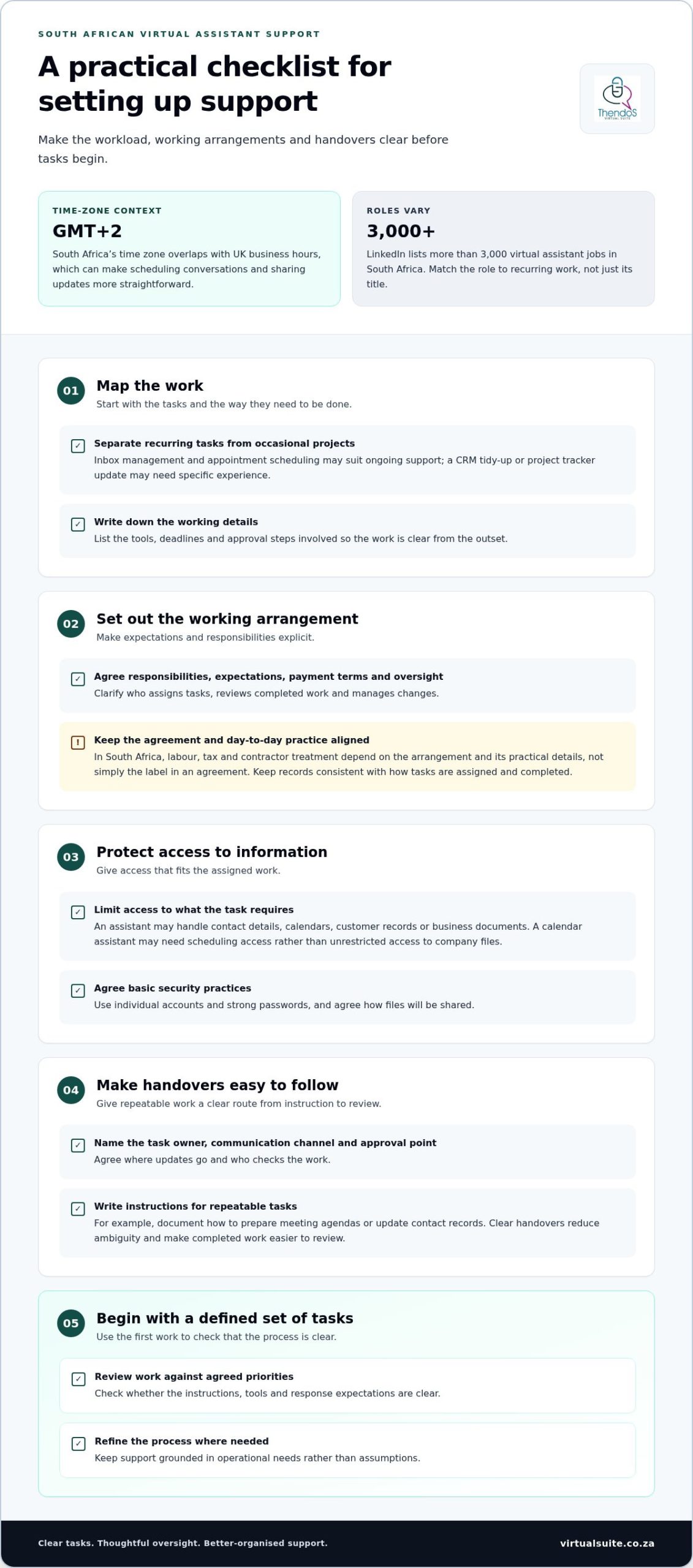
South Africa’s GMT+2 time zone overlaps with UK business hours. That can make scheduling conversations and sharing updates more straightforward. LinkedIn lists more than 3,000 virtual assistant jobs in South Africa, reflecting varied roles and experience. Match the role to your recurring workload, not just its title.
Start with a task list. Separate work that needs daily attention from occasional projects. Inbox management and appointment scheduling, for example, may suit ongoing support, while a CRM tidy-up or project tracker update may require specific experience. Note the tools, deadlines and approval steps involved so the work is clear from the outset.
Next, define how the working relationship will operate. In South Africa, labour, tax and contractor treatment depend on the arrangement and its practical details, not simply the label in an agreement. Set out responsibilities, working expectations, payment terms and oversight clearly, and keep the records consistent with how tasks are assigned and completed.
Data security deserves equal attention. A virtual assistant may handle contact details, calendars, customer records or business documents. Limit access to the information needed for assigned tasks, use individual accounts and strong passwords, and agree on file-sharing practices. A calendar assistant, for example, may need scheduling access rather than unrestricted access to company files.
Before work begins, agree on a straightforward handover process. Name the task owner, preferred communication channel and approval point. Provide written instructions for repeatable work, such as preparing meeting agendas or updating contact records. Clear handovers reduce ambiguity and make completed work easier to review.
Begin with a defined set of responsibilities. An initial task list can show whether the instructions, tools and response expectations are clear. Review the work against agreed priorities, then refine the process where needed. This keeps support grounded in operational needs rather than assumptions.
Managed staffing plans and prices
A managed support arrangement organises assistance around agreed tasks and oversight. For example, a business might group inbox management, appointment scheduling and meeting preparation. Define who sets priorities, reviews completed work and handles changes. Clear responsibilities make the scope easier to understand.
Price depends on the case and is given after a quote request; the main factors are task scope, hours, specialist skills, management and coordination. A plan covering routine administration differs from one involving CRM records or project tracking. More complex workflows may also need additional instructions and review. Define the work before comparing proposed plans.
Support can be shaped around recurring needs or a defined project. Ongoing assistance may suit weekly calendar updates and customer-record maintenance; a project with a clear completion point may suit a CRM tidy-up. List the deliverables, frequency and approval steps so the arrangement reflects the actual workload rather than a broad job title.
Agree on payment methods and currency before work starts. Record the chosen method, such as bank transfer or an agreed digital payment service, in the terms. For local arrangements, specify whether invoices and payments use South African rand (ZAR). For cross-border work, state the invoice currency and who is responsible for any conversion or transfer charges.
Compare support arrangements by reviewing their scope, communication process and reporting. For example, establish whether task updates will appear in shared project records or come through scheduled check-ins. Agree on how urgent changes are prioritised and how additional work is handled. These details reveal how clearly the support is managed.
Before accepting a proposal, match each cost factor to a practical need. Separate essential tasks from occasional requests, then note which require specialist judgement. A calendar update may need a simple checklist, whilst CRM maintenance may require defined data standards. If you’re organising these responsibilities, explore a structured support approach.
Virtual assistant skills and roles
Match responsibilities to the judgement each task requires. An administrative assistant might prepare meeting notes and organise shared files; an executive assistant may coordinate priorities across calendars. Customer support may involve sorting enquiries and drafting replies for approval. In every case, clarify role boundaries and provide access to the tools needed.
Written communication matters when an assistant represents your business. Someone handling customer enquiries needs guidance on tone, response templates and when to escalate a query. Research support calls for careful source tracking and concise summaries. Spreadsheet work requires consistent data entry, checks for missing fields and clear file names. These capabilities are useful when arranging virtual assistant support in South Africa.
- Administration: prepare documents, maintain records and organise meeting materials.
- Customer support: categorise enquiries, draft responses and flag complex requests.
- Research: gather information, record sources and summarise findings.
- Operations: update task trackers and document repeatable processes.
For South African businesses, local context can shape routine tasks. An assistant supporting a sales team might organise supplier details or prepare customer lists by region. Agree on terminology, record formats and escalation contacts to maintain consistency in client communications and internal records.
Some responsibilities require more specialised skills. A project assistant should be comfortable tracking owners, milestones and outstanding actions. A data-focused assistant may clean spreadsheets, standardise categories and prepare summaries. For accounting administration, define which records to organise and how they will be reviewed. Keep decisions and approvals with the appropriate person.
Before assigning work, write a brief role profile with recurring duties, tools, access permissions and examples of completed work. Then use a practical task to assess the approach, such as organising a sample folder or summarising notes. Review accuracy, clarity and how well instructions are followed. This makes it easier to assess fit for virtual assistant support in South Africa.
Finally, distinguish routine execution from work that requires your judgement. An assistant can prepare options for a supplier meeting, while you make the selection. Clear handover points support daily operations without blurring responsibility.
How do South African virtual assistant agencies compare with freelance platforms?
An agency and a freelance platform organise hiring differently. An agency can coordinate support around a defined business need, while a platform lets you compare individual profiles and arrange work directly. An agency may suit ongoing inbox and calendar administration; a platform may suit a one-off spreadsheet tidy-up. The right fit depends on how much oversight you want to manage.
With an agency, the service may include task coordination and structured communication. Clarify who assigns work, tracks progress and handles changes. A project tracker, for example, needs consistent updates and clear ownership. Ask how the workflow will be managed, as processes and support can differ between agencies.
A freelance platform offers direct access to individual professionals. You can review profiles, discuss a defined task and agree on working arrangements. This can give you more direct control, but you will also manage instructions, reviews and continuity. For recurring CRM updates, document the fields, naming conventions and approval steps before work begins.
- Coordination: decide whether you’ll manage task allocation or prefer an agreed support structure.
- Scope: compare a defined project, such as cleaning contact records, with ongoing operational tasks.
- Continuity: consider how handovers will work if an assistant becomes unavailable.
- Communication: agree channels, update frequency and escalation points before assigning work.
Compare the full working process, not just the profile or proposal. A suitable assistant should understand the task, required tools and expected result. For example, ask them to outline a process for preparing meeting agendas, then assess the clarity of the steps and how approvals are handled. Record the agreed scope and terms in writing.
Choose the arrangement that matches your capacity to supervise. If you want coordinated day-to-day assistance, explore virtual assistant support as a structured option for your operations.
Thendo’s Virtual Suite: Virtual assistant support
Thendo’s Virtual Suite provides virtual assistant support and structured operational support for founders, professionals and growing businesses. Consider this support when recurring tasks are drawing attention away from core responsibilities or business processes need clearer coordination.
Support can include Calendar Management, CRM Management and Project Management. Calendar assistance helps organise appointments, while project coordination brings tasks and ownership into clearer view. The right focus depends on the operational work you want to delegate.
Share the tasks that need attention and the outcomes you’re working towards. That creates a practical starting point for discussing suitable support. To explore the next step, visit Thendo’s Virtual Suite.
Make your next step a considered one
Start by identifying the work that interrupts your focus most often. Note which responsibilities need regular attention and what a successful handover would look like. This turns a broad need for virtual assistant support in South Africa into a practical conversation about your priorities.
Thendo’s Virtual Suite can discuss your needs and help identify tasks suited to operational support. Bring a short outline of your workload and the outcomes you want to achieve. A focused conversation helps you decide what to delegate.
Book a free consultation with Thendo’s Virtual Suite to explore a suitable next step. You can move forward at a pace that feels right for your business.
Frequently Asked Questions
Why South African virtual assistants?
South African assistants can be a practical fit for businesses needing regular collaboration with UK teams. The GMT+2 time-zone overlap can make live discussions and timely clarification easier to arrange. For example, a team can discuss a customer handover during shared working hours, rather than relying solely on messages across different schedules. Consider how much real-time communication your tasks require.
What services do virtual assistants in South Africa typically offer?
Virtual assistants can support administrative, communication and operational work, including inbox management, scheduling, travel planning, customer follow-ups and document preparation. Support may also include content scheduling, expense tracking, CRM updates and project coordination. Thendo’s Virtual Suite offers Executive & Administrative Support, Customer Support and Business Tools & Systems Support, shaped around business requirements.
How much does a virtual assistant cost in South Africa per hour or month?
The cost depends on the workload, task complexity, required skills and level of coordination. An hourly arrangement and a monthly arrangement can reflect different scopes, so compare what each covers rather than looking at the billing period alone. For a tailored quote, define the responsibilities and expected workload first. This gives the proposed support a clear basis, without relying on a generic rate.
Where can I hire a reliable virtual assistant in South Africa?
You can approach a virtual assistant business directly or use a platform to review individual profiles. Thendo’s Virtual Suite provides support for founders, busy professionals and growing businesses across South Africa. Prospective clients can book a free consultation to discuss business challenges and support requirements. Prepare a short task list to make your priorities clear.
What qualifications and experience should I look for when hiring a virtual assistant?
Look for relevant experience, clear communication and familiarity with the tools your tasks require. Someone handling CRM updates, for example, should understand accurate record-keeping and consistent data entry. A practical task, such as organising a sample task list or preparing a meeting summary, can help you assess attention to detail and ability to follow instructions.
How do I hire and onboard a virtual assistant in South Africa?
Begin by defining the work, then agree on the support plan and access requirements. Thendo’s Virtual Suite describes its process as Discovery, Support Plan, Onboarding, Offload Core Tasks, Ongoing Support and Scale With Confidence. During onboarding, document task instructions, communication preferences and approval points. Start with agreed responsibilities, then use ongoing support to refine workflows as business needs change.

Article by
Thendo Sadiki
CEO of Virtual Suite