

A virtual assistant can take recurring tasks off your plate, from organising calendars and setting appointments to updating customer records and coordinating routine work. Virtual assistant services are most effective when responsibilities are clear and support fits the way your business operates. The goal is not simply to delegate, but to create dependable space for the work that needs your attention.
It’s natural to think of a virtual assistant as support with administration. The right fit can also bring structure to everyday processes, provided expectations, communication and ownership are agreed from the outset.
This guide explains what virtual assistants do and how they can support appointment setting. It also considers how to assess quality, reliability and fit for a South African business. You’ll find practical ways to define the work, decide whether support suits your needs and take a considered next step.
Key Takeaways
- Map recurring tasks and define what a successful handover should look like before bringing in support.
- For appointment setting, agree how bookings, changes and follow-ups should be handled.
- Assess reliability through clear communication, consistent processes and careful handling of business information.
- Choose support that aligns with your priorities, existing systems and preferred way of working.
Hiring and evaluating virtual assistants
Start with a task list, not a job title. Identify recurring work such as inbox sorting, calendar updates or CRM record maintenance, then describe the outcome each task should achieve. For example, an appointment request might require a confirmed time in the calendar and a clear update to the relevant person.
Next, prepare a brief covering priorities, access boundaries, preferred communication and how completed work should be reported. Use a representative task to assess accuracy, judgement and written communication. A clearly defined example reveals more than a general claim of administrative experience.
In South Africa, personal information handled by a virtual assistant should be protected in line with applicable data-protection requirements. Agree which information they may access, how it may be used, where it is stored and when access ends.
Match tools to the tasks: calendar and email tools can support scheduling, while a CRM records customer interactions. Video calls or business messaging can clarify instructions, and a shared task board can show ownership and progress.
Assess the working relationship through observable practices, not polished claims alone. The National Library of Medicine notes that stored voice data can be misused by unauthorised parties to identify individuals, so consider the sensitivity of the information involved in each task.
- Accuracy: Check whether records and instructions are handled consistently.
- Communication: Look for clear updates when priorities change or details are missing.
- Discretion: Set boundaries for confidential files, conversations and account access.
Before delegating ongoing work, agree how to raise corrections and update processes. These steps help you judge whether virtual assistant support fits your workflows, communication style and expectations for handling information.
Treat that range as a starting point, then compare proposals against the responsibilities, expected availability and level of oversight involved.
The Forbes Advisor evaluation considered 17 virtual assistant service providers and 45 virtual assistant provider plans, examining 30 metrics when comparing virtual assistant services. A structured comparison can help you assess whether a provider’s offering aligns with your defined tasks, communication needs and information-handling expectations.
Appointment setting
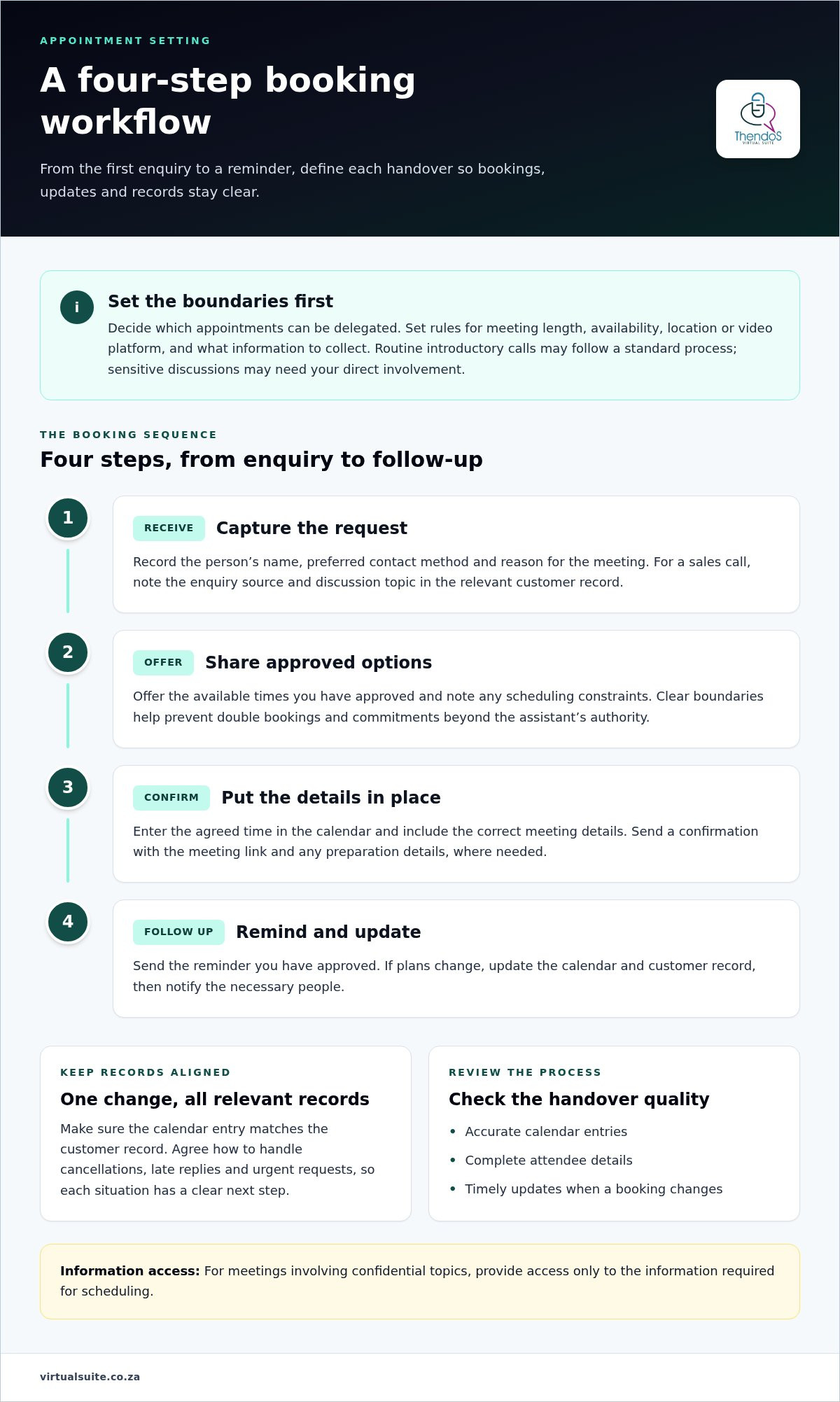
Appointment setting can involve more than adding a meeting to a calendar. A virtual assistant may coordinate a booking from the first enquiry to a reminder, following the process you define. For example, a prospective client might request a consultation by email, receive available times, then get a confirmation with the meeting link and preparation details.
First decide which appointments are suitable for delegation. A routine introductory call may follow a standard booking process, while a sensitive discussion could require your direct involvement. Set rules for meeting length, availability, location or video platform, and the information to collect before confirming. Clear boundaries help prevent double bookings and promises beyond your authority.
- Receive: Record the person’s name, preferred contact method and reason for the meeting.
- Offer: Share approved time options and note any scheduling constraints.
- Confirm: Enter the agreed time in the calendar and include the correct meeting details.
- Follow up: Send the reminder you’ve approved and update the calendar if plans change.
Consistent record-keeping matters. For a sales call, note the enquiry source and discussion topic in the relevant customer record, then make sure the calendar entry matches. If a booking changes, update both records and notify the necessary people. Decide how to handle cancellations, late replies and urgent requests, so each situation has a clear next step.
Review the process using practical signs: accurate calendar entries, complete attendee details and timely updates when a booking changes. If meetings involve confidential topics, give access only to the information required for scheduling. A documented appointment-setting workflow can help connect calendar coordination with your wider administrative processes.
Assistant quality and reliability
Risks include missed instructions, inaccurate records, delayed work and inappropriate access to business information. Reduce them with a written scope, limited account permissions, clear approval points and a review process for completed tasks.
Measure performance against agreed outcomes, not general impressions. For example, track whether customer records are complete, calendar changes are handled correctly and assigned tasks are finished by their agreed deadlines.
Set expectations before work begins. A task brief can explain the required result, who approves exceptions and where progress is recorded. For invoice administration, specify which details must match the source document and which discrepancies need your decision.
- Accuracy: Review a sample of CRM updates for missing or inconsistent information.
- Timeliness: Compare completed work with agreed deadlines and note recurring delays.
- Communication: Assess whether the assistant flags blockers early and provides useful progress updates.
Use these indicators in regular check-ins, alongside examples of work that needed correction. If errors recur, identify whether the cause is unclear instructions, outdated information or a process that needs revision. Then update the task guidance and review the next batch of work.
Reliability also depends on continuity. Document recurring procedures, keep essential decisions in an agreed shared record and define who handles urgent exceptions. For example, a calendar change can be logged with its reason, the person notified and any follow-up still due.
Keep feedback specific and balanced. Refer to the record or task, explain the expected standard, then agree on a practical adjustment. A short review of completed work can show whether quality is improving and responsibilities remain a good fit.
For virtual assistant support, these measures provide a grounded way to assess day-to-day performance. They also help distinguish an individual mistake from a recurring process issue, so you can respond with a useful correction rather than a vague judgement.
How to choose a virtual assistant service
Choose support by matching the work to the operating model. A founder needing occasional diary coordination may prefer one independent assistant; a growing team managing customer records and projects may value broader operational capacity. Start with the tasks, decision boundaries and communication rhythm, then compare how each option handles them.
Freelancers often offer a direct working relationship and may suit a clearly defined set of tasks. An agency can provide a more structured service arrangement, which may suit businesses seeking coordinated support across different responsibilities. The right choice depends on the work’s complexity, continuity needs and preferred way of collaborating.
South African businesses can work with independent virtual assistants, local providers or agencies that accept remote clients. Compare options by service scope, communication approach and ability to work within your established processes, rather than relying on a broad label alone.
Use a practical comparison before making a decision:
- Scope: Match the provider’s work to your priority tasks, such as diary coordination or CRM updates.
- Working method: Establish how tasks are assigned, progress is shared and decisions are escalated.
- Continuity: Consider how recurring procedures and key information will be documented.
- Fit: Discuss a realistic example, such as handling a changed appointment or an incomplete customer record.
Then define a manageable starting scope. Choose recurring tasks with clear outcomes, agree what requires your approval and set a review point. This gives everyone a practical basis for refining responsibilities before expanding them.
For example, if diary changes cause repeated interruptions, begin with scheduling and related updates. If customer records are the concern, define the fields to maintain and how to raise exceptions. A focused brief makes comparisons more meaningful and helps you assess whether the working arrangement suits your business.
For practical guidance on setting responsibilities, communication routines and early reviews, see this guide to virtual assistant onboarding.
If you’re ready to explore support aligned with your priorities, review virtual assistant support as a possible next step.
Thendo’s Virtual Suite: Virtual assistant support
Thendo’s Virtual Suite provides virtual assistant support for founders, professionals and growing businesses that need help with recurring operational work. Consider this support when calendar coordination, customer records or project tasks are taking attention away from your core responsibilities.
Support can include structured operational support, CRM Management and Project Management. For example, you might need help maintaining customer information alongside clearer coordination of ongoing work. Defining the tasks and desired outcomes gives the working relationship a practical starting point.
If you’re considering support, explore Thendo’s Virtual Suite website and get in touch to discuss your needs.
Make your next step manageable
Delegation works best when it starts with a clear purpose. Choose one recurring responsibility that would benefit from consistent attention, then define what a satisfactory result looks like. This gives you a practical way to assess how virtual assistant services could fit your business.
As priorities develop, refine the responsibilities and working arrangements to suit your routines. A considered starting point makes it easier to move forward at a pace that works for your business.
Book a free consultation with Thendo’s Virtual Suite to discuss your support needs and explore a suitable next step.
Frequently Asked Questions
What does a virtual assistant do?
A virtual assistant completes delegated administrative, operational or communication work remotely. For example, a consultant might delegate inbox organisation and client follow-ups, then reserve their own time for preparing advice. The assistant follows agreed instructions and uses the relevant business tools. The role can focus on one recurring responsibility or cover several connected tasks, depending on the business’s needs.
What tasks do virtual assistant services typically handle?
Virtual assistant services can include inbox management, scheduling, customer communication, document preparation, CRM updates and workflow support. For example, a business might ask for enquiry details to be recorded and a follow-up reminder prepared for review. Other responsibilities can include travel planning, expense tracking or content coordination. Start by identifying work that can be clearly delegated without transferring decisions that need your judgement.
What should businesses look for when choosing a virtual assistant?
Look for a fit between the assistant’s experience and the actual work, then discuss how they would approach a realistic task. For example, present an incomplete customer enquiry and ask how they would organise the details and flag missing information. Their response can reveal attention to detail and judgement. Also consider whether their communication style and familiarity with your working tools suit your team.
How do you hire and onboard a virtual assistant?
Begin by identifying the support you need and discussing suitable responsibilities. At Thendo’s Virtual Suite, the process moves through Discovery, Support Plan, Onboarding, Offload Core Tasks, Ongoing Support and Scale With Confidence. During onboarding, clarify task ownership, access requirements and where instructions are recorded. Defined responsibilities give everyone a shared reference for carrying out the work and adapting support as needs change.
What privacy and data protection rules apply to virtual assistants in South Africa?
Virtual assistants handling personal information should protect it in line with applicable data-protection requirements. Agree which information they can access, how it may be used and stored, and when their access ends.
Which virtual assistant companies serve clients in South Africa?
Thendo’s Virtual Suite provides virtual assistant support. South African businesses can also work with independent assistants, local providers or agencies that accept remote clients.

Article by
Thendo Sadiki
CEO of Virtual Suite