

Operational support becomes valuable when routine administration, inconsistent processes or limited performance tracking distract you from running your business. In South Africa, operational support services can help organise these activities, clarify how work gets done and make progress easier to monitor. The need may arise during growth, a change in workload or when important tasks rely too heavily on one person.
It can be difficult to improve operations while managing daily responsibilities. This article explains what operational support can cover, how to recognise when your business may need it and how to assess the help that fits. You’ll also learn how practical systems and regular reviews can support consistent work without adding unnecessary complexity.
Key Takeaways
- Spot when recurring delays, unclear responsibilities or missed follow-ups signal that a process needs attention.
- Map routine administrative tasks to see what can be organised, delegated or handled more consistently.
- Choose a small set of meaningful performance measures and review them regularly to guide improvements.
- Use structured operational support when day-to-day coordination is taking attention away from your core work.
Business performance and process improvement
Business performance improves when you can see where work slows down and what needs attention. Start with one process, such as responding to a new enquiry. Record who receives it, who follows up and where progress is tracked. This simple map can reveal repeated data entry, unclear ownership or delays between team members.
Operational support services in South Africa can help document process steps, clarify responsibilities and keep routine work moving. Outsourcing can provide extra capacity and more consistent administration, but unclear responsibilities, access or reporting expectations can disrupt the work. Define the tasks, decision boundaries and reporting arrangements before work begins.
Use a practical improvement cycle: map the current process, identify a recurring obstacle, then test a specific change. For example, a consultancy could record incoming leads in one CRM instead of spreading follow-ups across email folders. Review whether the change reduces missed handovers and makes the next action clear. Keep the process simple enough for the team to use consistently.
Track a small set of measures tied to the task. For lead management, review response time, completed follow-ups and enquiries awaiting action. For project work, monitor overdue tasks and unresolved dependencies. Compare results over time, then adjust the process when a bottleneck recurs. Avoid collecting figures nobody uses to make decisions.
Scope matters because “operations support” can describe very different work. Some South African technical listings require an NTC 3 or equivalent qualification for technician roles, while administration has different responsibilities. Match the support arrangement to the work, document handovers and review access to business systems. For telecom equipment, ETSI notes that open, standardised interfaces support management across vendors and technologies, an example of why compatibility matters.
Business administration and operational support
Operational support needs vary across South Africa’s provinces and industries. The work depends on local business activity, customer expectations and the tasks a team must complete. A professional-services firm may need help preparing client documents, while a retailer may need routine records and supplier correspondence organised. Identify the pressure points in your own working environment rather than assuming every business needs the same support.
Businesses can use outsourced operations providers, administrative support businesses or virtual assistant services. A virtual assistant can coordinate information between internal teams and external contacts. For example, a growing consultancy could delegate meeting arrangements and document preparation while keeping client decisions with its own staff.
For an outsourced task, establish which legislation and regulatory requirements apply to the activity and its records. Set out responsibilities, information access and handling expectations in the written agreement. Requirements for routine scheduling may differ from those involving sensitive business records or regulated work.
Assess whether support fits your tasks, systems and communication practices. During onboarding, walk through a representative task, agree how to raise questions and identify who approves completed work. Begin with a clearly defined responsibility, then review the arrangement before expanding its scope.
Where recurring administration needs steadier ownership, structured operational support can help bring responsibilities into a clearer working arrangement.
Job requirements also show how varied these roles can be. A South African operations support administrator listing requires 1-2 years of experience in administration or operational support, preferably in logistics or freight forwarding. A South African administrative lead and operations-support listing requires at least 6 years of administrative experience, including substantial operations or manufacturing support.
A South African operations support technician listing requires at least 2 years of experience in technical support, maintenance or operations in manufacturing. LinkedIn lists 4,000+ operations support jobs in South Africa. An operations support assistant role may include liaison between the operations department and internal teams or external vendors, reinforcing the value of clear ownership and communication channels.
Ongoing reporting and performance optimisation
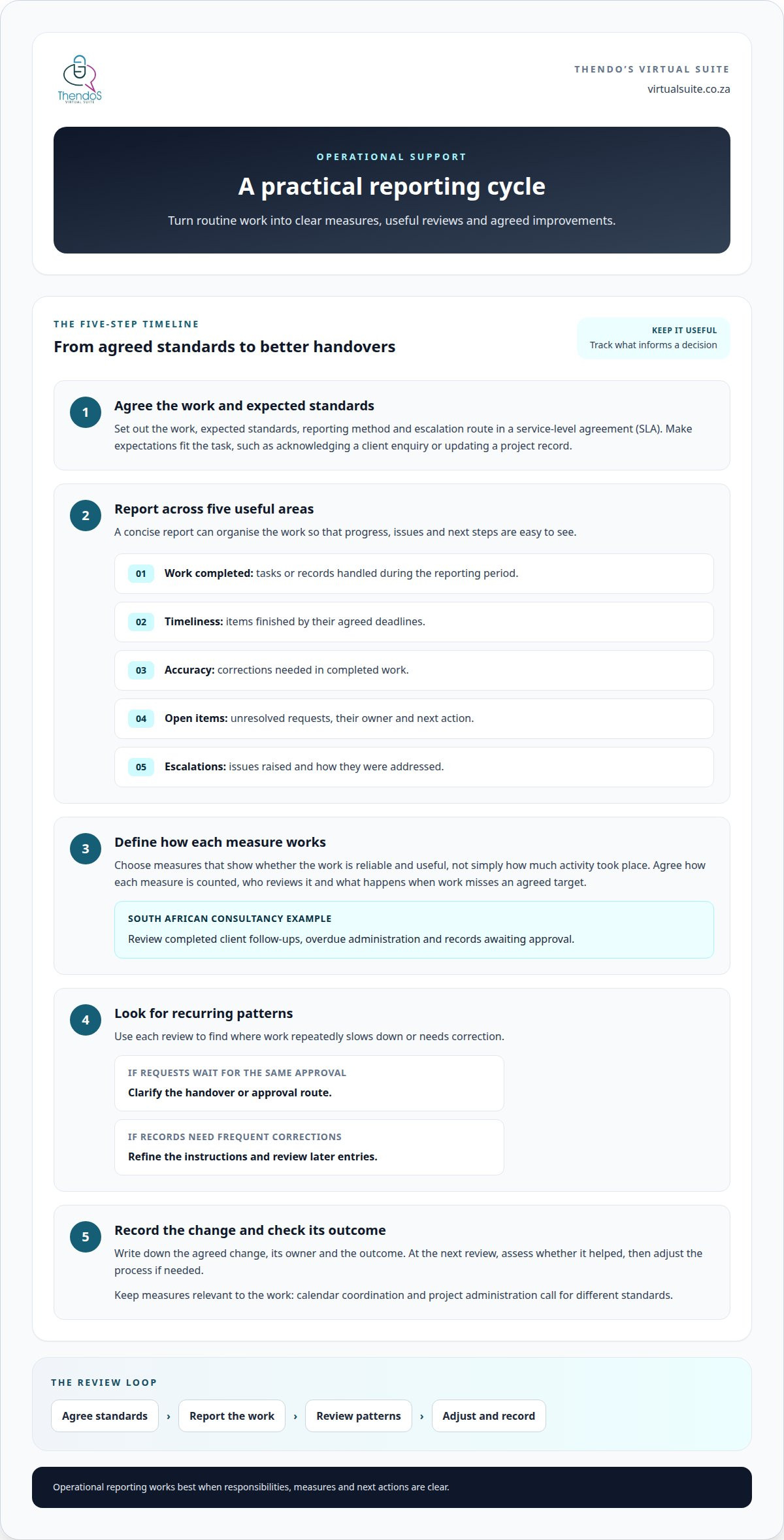
A service-level agreement (SLA) should describe the work, expected standards, reporting method and escalation route. Set response and completion expectations around the task, such as acknowledging a client enquiry or updating a project record. Clear wording gives both sides a shared basis for reviewing delivery and resolving misunderstandings.
Select measures that show whether the work is reliable and useful, rather than simply counting activity. A South African consultancy could track completed client follow-ups, overdue administration and records awaiting approval. Define how each measure is counted, who reviews it and what action follows when work misses an agreed target.
A concise report could group findings under these headings:
- Work completed: tasks or records handled during the reporting period.
- Timeliness: items finished by their agreed deadlines.
- Accuracy: corrections needed in completed work.
- Open items: unresolved requests, their owner and next action.
- Escalations: issues raised and how they were addressed.
Use each review to spot patterns and agree practical adjustments. If requests repeatedly wait for the same approval, clarify the handover or approval route. If records need frequent corrections, refine the instructions and review later entries. Record the change, its owner and the outcome so the next review can assess whether it helped.
Keep the SLA relevant to the work. Calendar coordination and project administration call for different measures, so agree standards that reflect the actual responsibilities. For support with clearer workflows and reporting routines, explore structured operational support.
Thendo’s Virtual Suite: Virtual assistant support
Thendo’s Virtual Suite can help when administration, client records or project coordination draw attention away from your core work. Virtual assistant support can take on agreed recurring tasks, while structured operational support helps organise how responsibilities are handled.
If client details are difficult to maintain, CRM Management can support record upkeep. If project tasks lack clear ownership or updates are scattered, Project Management can help keep coordination in view. Start by identifying the work you want to delegate, the information needed to complete it and the decisions that should remain with you.
A clear handover gives support a practical starting point. Note the usual steps, where key information is kept and how completed work should be shared. This helps establish responsibilities and gives you a basis for reviewing whether the arrangement fits your working routines. To discuss suitable support for your business, contact Thendo’s Virtual Suite.
Choose a practical next step for your operations
Before changing how work gets done, decide which recurring pressure to address first. It might be an administration backlog, unclear task ownership or client information spread across several places. A focused starting point makes it easier to describe the support you need and how it should fit your existing routines.
If you’re considering operational support services in South Africa, turn that pressure into a clear brief. Note the task, the outcome you need, the systems involved and how you’ll recognise improvement. This gives you a useful foundation for discussing suitable support with Thendo’s Virtual Suite.
Discuss your operational support needs with Thendo’s Virtual Suite, and take the next step towards a more manageable working day.
Frequently Asked Questions
What are operational support services in South Africa?
Operational support services in South Africa help businesses organise and complete recurring work outside their core delivery. They can suit a founder whose client enquiries, records or scheduling are becoming difficult to coordinate. Define which tasks need attention, what information the support person needs and how completed work should be handed back.
What types of operational support services are available to South African businesses?
Operational support services in South Africa can include virtual assistant support, Executive & Administrative Support, Project Coordination, Customer Support, Finance & Administrative Support, and Business Tools & Systems Support. A consultant might delegate document preparation and appointment scheduling, then organise CRM updates as part of client administration. The right tasks depend on the business’s priorities.

Article by
Thendo Sadiki
CEO of Virtual Suite