

The person who takes work off your desk may not be the person who improves the processes that keep it landing there. A virtual assistant can manage recurring tasks such as inboxes, calendars, follow-ups and CRM updates. Operational support focuses on the systems and workflows behind the work. The right choice depends on whether you need reliable task delivery, stronger processes, or both.
It’s natural to focus on the tasks you want to delegate, but the scope of responsibility matters just as much. This guide explains the difference in the virtual assistant vs operational support decision, the skills each involves, when each is useful, and how scope and complexity affect costs. You’ll also see how these forms of support can work together to help a South African business manage its operations more clearly.
Key Takeaways
- Identify whether you need recurring tasks completed or underlying workflows improved before deciding what kind of support to bring in.
- Consider how organisation, communication and attention to detail align with the work you want delegated.
- Assess the scope and complexity of the responsibilities, as these shape the support required and its cost.
- Explore how virtual assistant support, structured operational support, CRM management or project management can address different business needs.
Definition of virtual assistant services
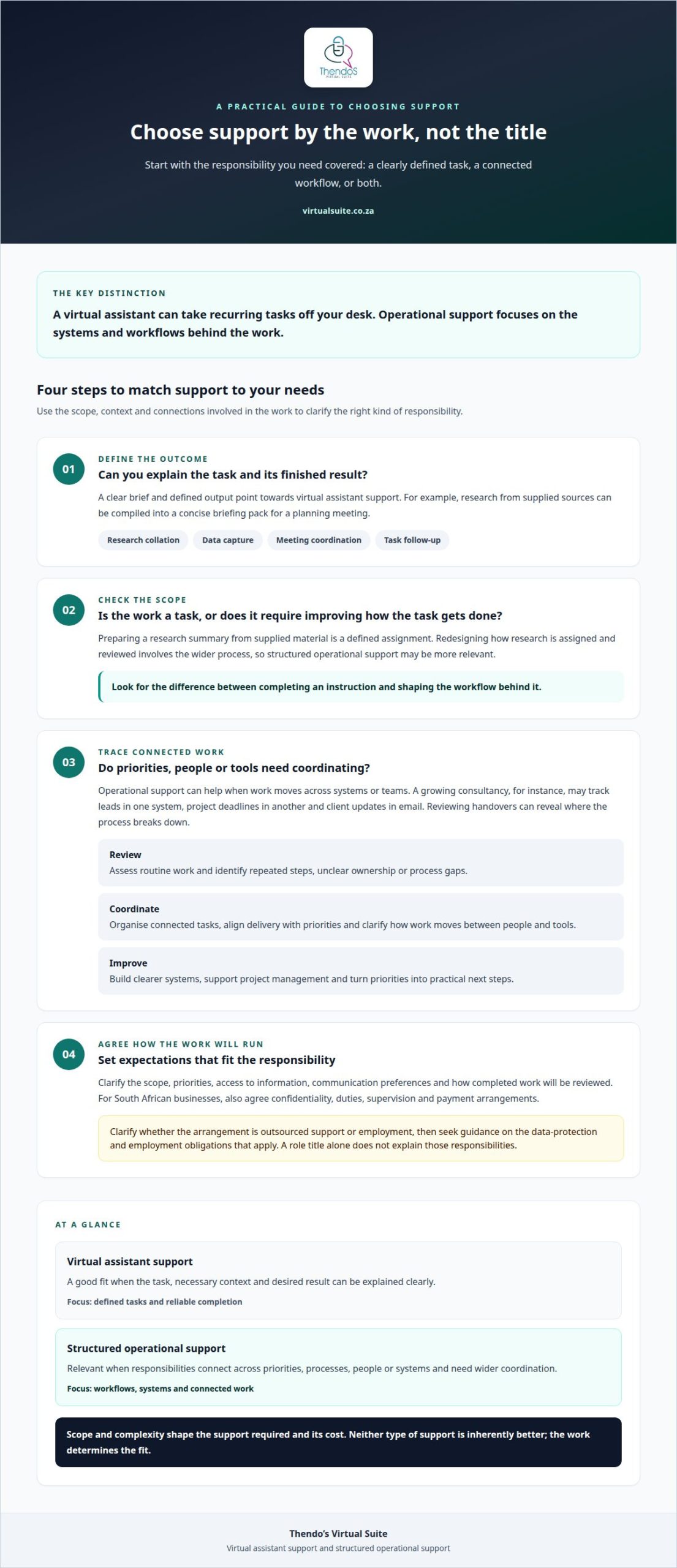
A virtual assistant provides remote administrative, technical or operational support to a business. For example, a consultant might delegate research collation and preparation of a briefing pack for a planning meeting. Working from the agreed scope and relevant business information, the assistant can produce material in the required format and for its intended purpose. This makes the role useful for defined tasks that compete with the owner’s priorities.
Virtual assistant responsibilities vary by business. Some assistants support one organisation, while others work remotely with several clients. When weighing virtual assistant vs operational support, ask whether the task has a clear outcome. Preparing a research summary from supplied sources is a defined assignment; deciding how the entire research process should work is broader.
- Documentation, such as organising business records.
- Data capture and updating relevant information.
- Meeting coordination and task follow-up.
- Research collation and briefing preparation.
For South African businesses, agree practical arrangements for information access, confidentiality, duties, supervision and payment. Clarify whether the engagement is outsourced support or employment, then seek guidance on the data-protection and employment obligations that apply to that arrangement. A role title alone does not explain those responsibilities.
A virtual assistant can be a good fit when you can explain the task, provide the necessary context and describe the desired result. For instance, asking for specified research to be compiled into a concise briefing gives the assistant a defined output. If the request involves redesigning how research is assigned and reviewed, the work extends beyond task completion.
Skills and costs of virtual operations assistants
Both roles call for organisation, communication and attention to detail. The difference lies in the judgement and responsibility required, not simply in the task title.
Virtual assistant and operational support trade-offs
A virtual assistant suits work with a clear brief and defined outcome, while operational support can suit responsibilities that require broader business context. A virtual assistant might prepare a meeting pack from supplied material; operational support may be appropriate when work needs coordination across several priorities. Matching the scope to the expertise required helps set clear expectations.
Clear expectations support good working relationships in either arrangement. Outline priorities, access to relevant information, preferred communication and how completed work will be reviewed. These practical details help establish the level of support and involvement needed without assuming one role is inherently better.
Operational support tasks
Operational support involves responsibility for connected work, where priorities and decisions affect one another. It calls for understanding how an assignment fits the wider business, rather than simply completing an isolated instruction. This broader perspective can help when routine requests arrive from different parts of a growing business and need coordinated attention.
For a founder, the difference may be visible in how much context they need to provide and how independently the work can proceed. Defined assignments allow focused execution; broader responsibilities need communication, sound judgement and alignment with business priorities. Structured operational support can be relevant when that wider coordination is needed.
Skills and the scope of responsibility shape the support a business needs. A well-defined assignment calls for accuracy and reliable communication; work involving connected priorities also calls for discretion, adaptability and a sound understanding of the intended outcome. Clarifying those expectations helps align the role with the work.
What does operational support mean and what tasks does it include?
Operational support helps organise how work is planned, assigned and completed. Rather than handling only a defined task, a specialist can examine how work moves between people, tools and processes. For example, a growing consultancy might track leads in one system, project deadlines in another, and client updates in email. Support can identify where handovers break down and help establish a clearer process.
The work can combine practical coordination with broader assessment. A specialist may review recurring delays, clarify ownership, improve systems and manage projects from planning through delivery. If an owner wants to improve client onboarding, support might map each stage, identify missing handovers and turn the intended client experience into an operational plan.
- Assessing operations: reviewing how routine work is currently handled.
- Finding inefficiencies: identifying repeated steps, unclear ownership or process gaps.
- Building systems: creating clearer ways to organise and complete work.
- Managing projects: coordinating connected tasks and keeping delivery aligned.
- Supporting decisions: translating business priorities into practical next steps.
This broader remit can matter when a business grows faster than its processes. For instance, a professional services firm may struggle to keep project updates, deadlines and client handovers consistent as its workload expands. Operational support can help align these activities, rather than simply completing an isolated administrative task.
The role also calls for sound judgement and a working understanding of the business. A specialist may need to balance competing priorities, communicate changes clearly and adapt a process when delivery reveals a gap. This supports a considered approach to operational continuity, with responsibilities tied to the business’s actual needs.
Thendo’s Virtual Suite: Virtual assistant support
Thendo’s Virtual Suite provides virtual assistant support for growing businesses and structured operational support for founders, professionals and growing businesses. If recurring administration needs reliable handling, its virtual assistant support can help organise tasks such as calendar management and CRM updates. If the challenge is unclear processes or disconnected responsibilities, structured operational support can help bring order to the work.
The distinction helps clarify what kind of support your business needs. Calendar management, for example, can ease the demands of scheduling, while project management can help coordinate connected work. CRM management can keep lead and client information organised, alongside administrative tasks that need consistent attention.
To discuss the support that fits your business, book a consultation with Thendo’s Virtual Suite.
Choose the support that moves work forward
The virtual assistant vs operational support decision is a chance to consider not only who handles the work, but what needs to change for it to run smoothly. Identify the pressure point your business faces now: a steady stream of recurring tasks, or processes that need clearer structure. Being specific about responsibilities, priorities and the working relationship will make the next conversation more useful.
For some businesses, the right arrangement may evolve as needs change. A defined administrative workload can become a broader operational challenge as the team grows. Focus on the work that needs attention rather than choosing a title before the scope is clear.
Thendo’s Virtual Suite offers virtual assistant support, structured operational support and CRM management to help address different business needs. Contact Thendo’s Virtual Suite to discuss the support that could fit your priorities. A clearer way of working can begin with one considered conversation.
Frequently Asked Questions
What does a virtual assistant do?
A virtual assistant takes on agreed work and follows the business’s communication standards. For example, they might draft a response to a client enquiry using approved guidance, then flag an unusual request for the business owner’s decision. Clear escalation boundaries help the assistant represent the business consistently without making decisions outside their remit.
What is a virtual assistant and what tasks do they typically handle?
A virtual assistant provides remote support for practical business or personal tasks. Depending on the agreed scope, this could include arranging travel, coordinating appointments, preparing documents or tracking expenses. A consultant travelling for a client engagement, for instance, might delegate itinerary preparation and appointment details while retaining responsibility for business decisions and client commitments.
What is the difference between a virtual assistant and operational support?
The roles differ in how much responsibility the work carries beyond its immediate output. A virtual assistant might prepare a first draft using supplied guidance, with approval remaining with the business owner. Broader operational responsibility may involve coordinating decisions across work areas. Defining who approves, who acts and when to escalate makes the distinction practical.
When should a business hire a virtual assistant versus operational support?
Consider how much ownership the work requires. If a founder can specify the output and review it, a virtual assistant may suit the assignment. If the work needs ongoing coordination across priorities or teams, broader operational support may fit better. For example, a business preparing a campaign could delegate content administration while keeping strategic decisions in-house.
What skills and qualifications are required for virtual assistant and operational support roles?
The required skills depend on the agreed responsibilities. A virtual assistant may need strong written communication, discretion and confidence using relevant tools, such as Google Workspace or Microsoft 365. Operational support may also call for project coordination and sound judgement. Rather than assuming one qualification fits every role, assess relevant experience against the actual tasks and decision-making expected.

Article by
Thendo Sadiki
CEO of Virtual Suite