

Recurring work often falters at the handover, not because of the task itself. To delegate business operations reliably, define the outcome, share the context and process, and agree how progress will be reviewed. Delegation works best when responsibilities are clear and constant approval is unnecessary.
It’s understandable to feel safer keeping familiar tasks close, especially when clients rely on consistent follow-up and details matter. A clear handover can protect continuity while giving leaders more time for decisions that need their attention. This article explains why delegation matters, how to set expectations and review progress without micromanaging, and which back-office tasks are often suitable to hand over. It also shows how process notes and practical check-ins make recurring work easier to repeat confidently.
Key Takeaways
- Identify recurring work that can be handed over so leadership attention stays with decisions that need your expertise.
- Make handovers clearer by setting out the expected result, relevant context, resources and deadline.
- Use agreed check-ins to monitor progress and offer guidance without managing every step.
- Explore which back-office responsibilities could be documented and delegated to support steadier operations.
1. Benefits of delegation for managers and businesses
Delegation means assigning someone else responsibility for a defined result while retaining oversight. For example, an associate can prepare routine client follow-ups, leaving a team leader free to focus on complex decisions.
Effective delegation helps managers focus on work that requires their expertise. It can also give employees ownership of specific responsibilities and opportunities to develop skills. A repeatable handover, such as preparing meeting notes using an agreed template, makes routine work easier to share.
When choosing between hiring, outsourcing and freelance support, consider whether the work is ongoing, project-based or requires close integration with your team. A defined design project, for instance, may suit freelance support, while regular administrative responsibilities may need ongoing assistance.
When comparing local and offshore providers, consider communication arrangements, relevant experience, confidentiality practices and how work is reported. In South Africa, document responsibilities and supervision, then seek professional advice about whether the arrangement is suitable as employment or contracting.
For tax, VAT and data protection, agree how records, invoices, access and business information will be handled. A South African accountant or privacy professional can assess the arrangement. Vet providers by reviewing relevant experience, discussing a sample task and agreeing deliverables in writing.
2. Maintaining communication and monitoring progress
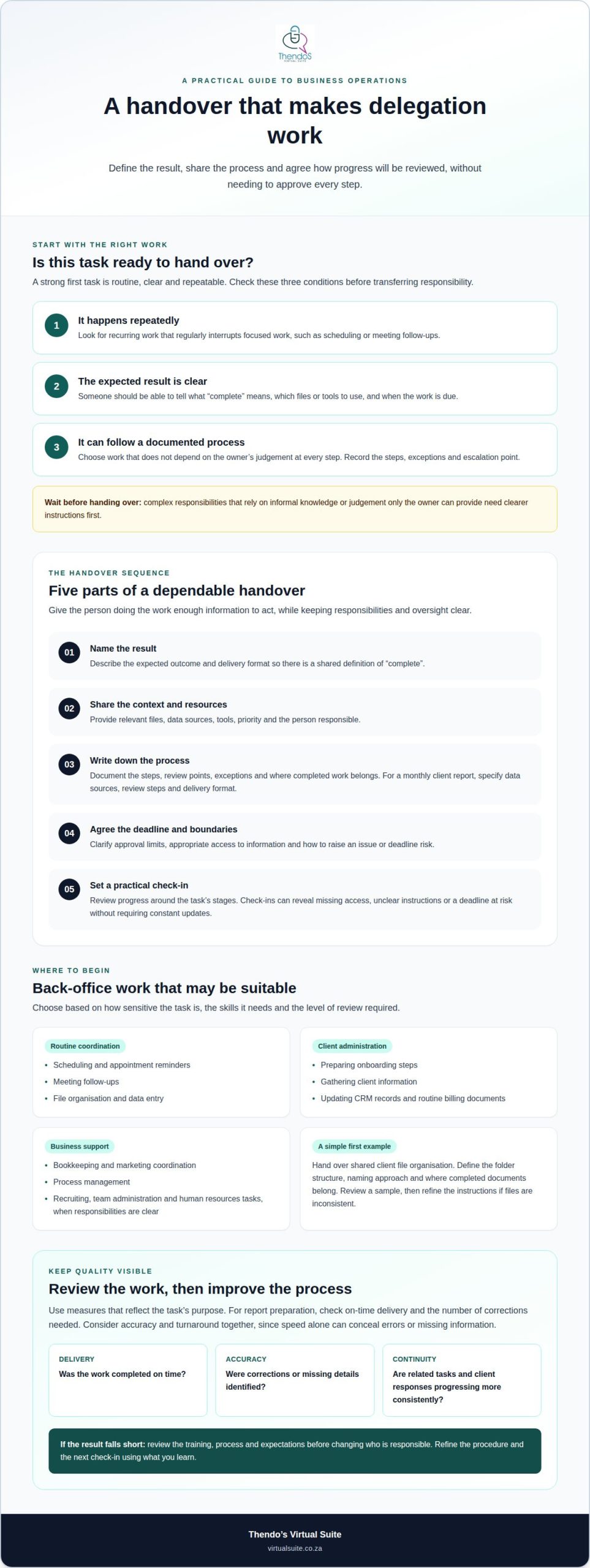
A useful handover records the expected result, deadline, priority, relevant files and person responsible. For example, an SOP for preparing a monthly client report can specify data sources, review steps and delivery format. Clear instructions help someone understand exactly what “complete” means.
Pair each SOP with a practical key performance indicator (KPI), a measure of whether the task is meeting its purpose. For report preparation, track on-time delivery and the number of corrections needed. Review these measures alongside the work, since speed alone can conceal errors or missing information.
Schedule check-ins around the task’s stages instead of asking for constant updates. A brief progress review can reveal missing access, unclear instructions or a deadline at risk. The Plan, Do, Check, Act feedback loop offers a straightforward way to review a process and make adjustments.
Delegation carries risks, including mistakes, delays, inconsistent quality and inappropriate access to information. Reduce them by documenting approval boundaries, limiting access to what the task requires and agreeing how to raise issues. If work falls short, review the training, process and expectations before changing who is responsible.
Assess whether delegation is helping by comparing the task’s completion, accuracy and turnaround with its previous performance. Note whether managers face fewer routine interruptions and related work, such as client responses, progresses more consistently. Use what you learn to refine the SOP and the next check-in.
For recurring work that needs clearer processes and follow-through, structured operational support can help establish practical handovers and review routines.
3. Back-office operations to delegate
For a small business, start with recurring work that follows a clear process and does not require the owner’s judgement at every step. Routine scheduling, file organisation, data entry and meeting follow-ups are practical starting points. Choose a task that regularly interrupts focused work, then document what a complete handover involves.
Client administration can also be delegated. An employee or support person might prepare onboarding steps, gather client information, update CRM records or issue routine billing documents. For example, a consultant could hand over appointment scheduling and follow-up reminders while retaining responsibility for advice and client decisions.
Bookkeeping, marketing coordination and process management are other possible areas to delegate. Recruiting, team administration and human resources tasks may also be suitable when responsibilities, access and approval boundaries are clear. The right fit depends on the task’s sensitivity, required skills and level of review.
Prioritise work that is recurring, well-defined and suitable for a documented procedure. Avoid starting with complex responsibilities that rely on informal knowledge or judgement only the owner can provide. Before transferring responsibility, record the steps, required tools, exceptions and escalation point.
A useful first handover could be organising shared client files. Define the folder structure, naming approach and where completed documents belong. Review a sample result, then refine the instructions if files are inconsistent. This turns a one-off handover into a repeatable process.
If recurring back-office tasks need clearer structure, organise operational handovers with practical support.
Thendo’s Virtual Suite
Thendo’s Virtual Suite helps founders bring recurring responsibilities into clearer, more manageable workflows. When handovers need structure, its operational support can help organise processes, coordinate tasks and maintain continuity across everyday business operations.
Support includes Executive & Administrative Support, Project Coordination, Business Tools & Systems Support and other services, depending on the work that needs attention. For example, a business with client details scattered across records may benefit from better-organised CRM processes, while a growing team juggling deadlines may need structured project coordination.
Consider support when routine administration takes time away from leadership, follow-ups are inconsistent or delegated work lacks a dependable process. Thendo’s Virtual Suite provides structured operational support to organise processes and keep responsibilities visible.
Contact Thendo’s Virtual Suite to discuss the operational handovers you’d like to make clearer.
Build a handover that can grow with your business
As your business changes, so will the responsibilities that need your attention. Treat delegation as an evolving part of how work is organised, not a one-off transfer. A process that suits a small team today may need clearer ownership, updated documentation or different review points as client needs and workloads shift.
Start with a recurring responsibility that would benefit from a more dependable handover. Make the desired outcome clear, then refine the process as the work is carried out. This creates a practical foundation for deciding when to delegate business operations more broadly, while keeping accountability and service quality in view. The aim isn’t to remove your oversight, but to focus it where it contributes most.
Thendo’s Virtual Suite can support businesses seeking a steadier approach to operational responsibilities. Contact Thendo’s Virtual Suite to discuss the handovers you’d like to strengthen. A considered next step can help you build greater clarity into the way work moves through your business.
Frequently Asked Questions
What Is Delegation and Why Is It Important?
Delegation can help essential work continue when a business owner is unavailable. For example, while a founder attends an industry event, a trained colleague could handle routine appointment confirmations using agreed guidance. This helps maintain continuity while the founder focuses on activities requiring their direct involvement.
How do I decide which tasks to delegate?
Consider whether a task is repeatable, clearly teachable and suited to someone else’s skills. Preparing meeting documents from an established template might be a good candidate. Before handing it over, identify the decisions involved and make sure the person has the tools and authority to complete it without unnecessary delays.
What are the 5 steps of delegation?
Use these five steps: identify a suitable task, choose the right person, explain the expected result, provide the necessary resources and support, then follow up with feedback. For example, when handing over meeting preparation, share the template and source documents, clarify who approves the final version and review the first completed handover together.
When Should You Start Delegating?
Start when recurring work competes with responsibilities that need your judgement, or routine requests regularly wait for your attention. One practical signal is repeatedly postponing a planning task because you’re handling the same administrative process. Begin with a manageable responsibility, allow time for learning and adjust the handover based on what happens.
When should I not delegate a task?
Keep a task with you when it depends on expertise or authority another person doesn’t yet have, or when a mistake could seriously affect a client relationship. A sensitive client decision, for instance, may require the business owner’s direct judgement. You can still delegate preparation, such as gathering relevant records, while retaining the decision.

Article by
Thendo Sadiki
CEO of Virtual Suite