

A growing business can become harder to run before it becomes bigger. When client enquiries, follow-ups, bookings and project updates compete for attention, routine work can crowd out the work that moves the business forward. A virtual assistant for business operations can take on defined administrative and coordination tasks remotely, keeping everyday work organised while owners focus on customers and business priorities.
That doesn’t mean handing over every process or adding complexity. The value comes from matching support to recurring tasks, clear workflows and the points where work tends to stall. In this article, you’ll learn how virtual assistants support business operations, which tasks they can handle, and how they fit into small businesses in South Africa. We’ll also explain how this practical support differs from the broader oversight of an operations manager, so you can see where it may fit as your business grows.
Key Takeaways
- Identify which recurring administrative and coordination tasks can be handled remotely, and how this support differs from an operations manager’s broader oversight.
- Consider how delegating routine work can give you more time for customer relationships, planning and other business priorities.
- Use clear task instructions and shared systems to help a virtual assistant coordinate work and keep small-business operations organised.
- Explore how structured support, CRM management and project management can help bring greater consistency to day-to-day operations.
What Is the Role of a Virtual Operations Assistant?
A virtual operations assistant provides remote support for the routines that help a business function. A business may engage one as a contractor for defined work, with responsibilities and confidentiality terms set out in an agreement.
Administrative, Bookkeeping and Clerical Tasks
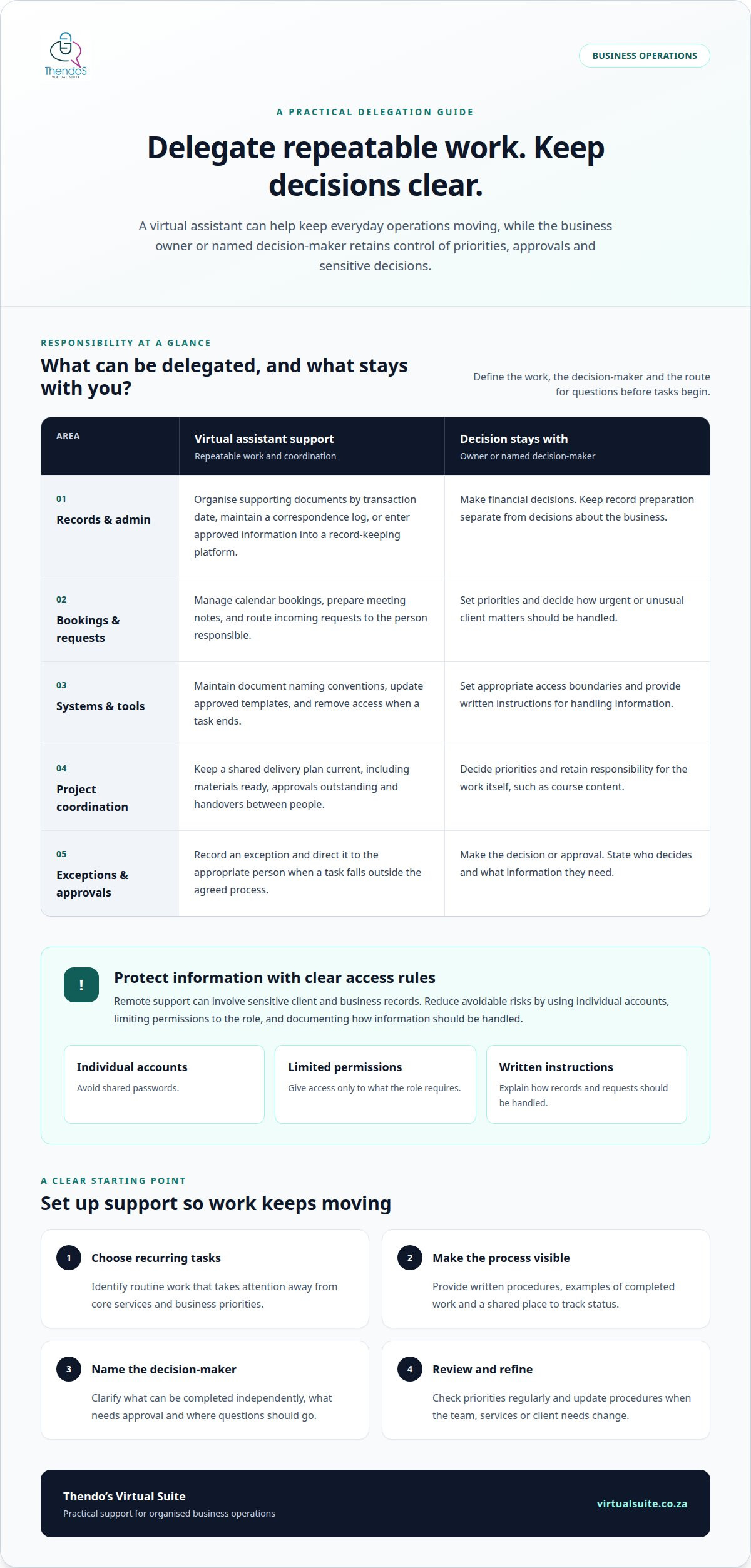
Administrative, bookkeeping and clerical work involves maintaining accurate records and preparing information for business use. An assistant might organise supporting documents by transaction date, maintain a correspondence log, or enter approved information into a record-keeping platform. For a small South African consultancy, consistent file names can help the owner locate a client document without searching through several folders. Clear procedures also help distinguish record preparation from financial decisions that remain with the business owner.
Personal and Operational Support
Personal Assistance and operational support can help business owners coordinate commitments and keep responsibilities visible. An assistant can manage calendar bookings, prepare briefing notes for a meeting or route incoming requests to the person responsible. For example, a consultant might direct urgent client matters to a designated contact and log routine requests for review. Clear boundaries prevent delegated support from becoming unauthorised decision-making.
Systems and Tools Administration
Business Tools & Systems Support helps keep platforms organised and access appropriate to each responsibility. An assistant could maintain document naming conventions, update approved templates or remove access when a task ends. Businesses should consider confidentiality risks such as accidental disclosure, shared passwords and access to records beyond the assistant’s role. Individual accounts, limited permissions and written handling instructions help protect sensitive client and business information during remote work.
How Can a Virtual Assistant Help Your Business?
A virtual assistant can help business owners give more attention to revenue-generating work and important decisions. The benefit depends on choosing responsibilities that genuinely ease operational pressure.
Business Benefits of Hiring a Virtual Assistant
A virtual assistant can take on a defined workload, helping owners maintain momentum without personally overseeing every administrative detail. For example, a consultant could delegate preparation of routine client documents and focus on delivering paid work. When choosing support, assess relevant experience, communication, judgement and familiarity with the platforms the role requires. Discuss confidentiality and decision-making boundaries before assigning sensitive responsibilities.
For a South African small business, start by identifying recurring work that takes attention away from core services. Freelance marketplaces can help businesses find candidates, while direct hiring arrangements may centre on agreed hours, part-time support or a specific project. Once selected, onboard the assistant with written procedures, examples of completed work and a named contact for questions. Regular reviews help clarify priorities and address misunderstandings early.
Hiring Costs and Overhead
The cost of hiring depends on the assistant’s experience, work scope, required availability and payment arrangement. Businesses may pay for hours worked or tasks completed. This can make the commitment more closely reflect the support required, rather than a full-time role with associated employee costs such as benefits, training, equipment and workspace.
Before agreeing to an arrangement, define the deliverables, review points and process for additional requests. This helps clarify what the agreed work covers and makes it easier to plan an operational budget without assuming every task requires ongoing support.
For a considered approach to delegation, explore practical business support.
Virtual assistants in small-business operations
In a small business, operational gaps often emerge when customer demand exceeds the owner’s available attention. A virtual assistant can provide consistent execution for agreed processes as responsibilities expand. The useful question is not only which tasks can be delegated, but where dependable follow-through would stop work from stalling.
Consider a training provider coordinating several courses. A virtual assistant could keep the shared delivery plan current, noting which materials are ready, which approvals are outstanding and where responsibilities pass between the organiser and facilitator. The business owner retains decisions about course content and priorities. A visible plan helps the team spot delays early and understand what needs attention before delivery.
This support is most useful when a process has clear decision points. If a task requires approval, specify who decides and what information they need. If an exception arises, the assistant can record it and direct it to the appropriate person rather than make an unauthorised decision. These boundaries make execution more reliable without obscuring accountability.
As the business grows, review whether each process still reflects how work is done. New team members, changing client needs or added services can create handover gaps. An assistant can help keep agreed procedures and status records aligned with current practice, while the owner identifies where improvement is needed. The practical takeaway is to delegate repeatable execution, make decision ownership visible and revisit workflows when the business changes.
Thendo’s Virtual Suite: Virtual assistant support
Thendo’s Virtual Suite supports business owners who need dependable help with recurring administrative work or clearer operational coordination. Executive & Administrative Support can help with inbox management, scheduling and day-to-day administration, while Project Coordination supports task tracking and workflow management. Customer Support and Business Tools & Systems Support can also help keep client communication and business systems organised.
This support may be useful when important tasks are repeatedly delayed, information is spread across platforms, or business owners need practical help maintaining established processes. The focus is on aligning support with the work that needs attention, rather than adding unnecessary complexity.
If you’re considering support for your business operations, contact Thendo’s Virtual Suite to discuss what would be useful.
Make your next operational decision deliberate
Before delegating another task, identify the recurring point where your attention is pulled away from work only you can do. A useful first handover has a defined outcome, a clear owner and a shared way to track completion. That gives a virtual assistant for business operations a practical place within your existing workflow, rather than adding another disconnected process.
You can begin with one pressure point, then refine the handover as your business needs change. The aim isn’t to remove your oversight, but to make responsibilities visible and keep essential work moving. With a considered handover, you can give more attention to leadership, client relationships and the decisions that shape your business’s direction.
For a measured next step, explore support from Thendo’s Virtual Suite and consider which operational responsibility would benefit most from focused attention. A clearer way of working can begin with one well-defined task, then develop alongside your business.
Frequently Asked Questions
What tasks do Virtual Assistants cover?
Virtual assistants can support administrative, personal, customer communication, finance administration, marketing coordination and project work. For example, they can plan travel, prepare documents, coordinate client enquiries or track expenses for reporting. The right tasks depend on the business’s needs and the assistant’s agreed responsibilities. Clear instructions help keep delegated work consistent with the way the business serves its clients.
What does a virtual assistant do for business operations?
A virtual assistant for business operations helps maintain the practical routines that keep work moving. This could mean updating client records after a meeting, preparing information for a team review or coordinating communications around a project. The assistant carries out agreed support tasks, while business owners retain responsibility for decisions, priorities and approval of the work.
Which business operations tasks can a virtual assistant handle?
A virtual assistant may handle tasks across client administration, internal coordination and business tools. For instance, they could update a HubSpot record after a new enquiry, organise shared documents in Microsoft 365 or Google Workspace, and prepare a project status update. Businesses can define which information the assistant may access and which decisions must remain with a manager or owner.
How much does a virtual assistant cost in South Africa?
The cost depends on the work involved, the experience required, the amount of support needed and how the arrangement is structured. A focused task, such as organising records, differs from ongoing assistance across several responsibilities. Before agreeing on support, outline the work, expected outputs and communication needs so the scope is clear and can be discussed appropriately.
How do South African virtual assistant rates compare with offshore and in-house staff?
There is no like-for-like comparison without considering the work and arrangement. Compare the same responsibilities, experience, hours and expected outputs, then account for whether support is remote or in-house and any applicable employment overheads. Different currencies and working arrangements may also affect offshore support. Looking beyond an hourly figure helps clarify which option suits the business’s operational needs.

Article by
Thendo Sadiki
CEO of Virtual Suite