

A lean workflow isn’t about asking people to do more with less. To understand how to organise business operations, map how work moves through the business, clarify responsibilities and remove steps that cause delays without improving the outcome. The aim is a dependable way of working that supports quality and makes better use of people, time and tools.
Organising operations can feel like a broad task: daily delivery, administration, customer service and planning all need attention. Operations management brings these activities into view, helping leaders see how they connect and where a clearer process could help.
This article explains what operations management covers and how lean workflows can make routine work easier to coordinate. It also explores resource management, practical goal-setting and performance measures, helping you build an approach that supports current priorities and adapts as the business grows.
Key Takeaways
- Map how people, processes, production and technology work together to spot friction and clarify responsibilities.
- Use communication, analysis and thoughtful resource allocation to keep daily work aligned and manageable.
- Set measurable operational goals, then track relevant performance indicators to see where workflows need attention.
- Distinguish ongoing operations from project work so routine delivery and time-bound initiatives are managed appropriately.
What Is Operations Management?
Operations management aligns people, processes, production and technology so daily work supports consistent delivery. It also gives leaders a practical way to review workflows, address delays and maintain quality as needs change.
People, Processes and Technology
Operations management coordinates the people, processes and tools involved in producing goods or delivering services. For example, a small bakery relies on staff schedules, preparation steps, ingredient stock and payment systems working together. A clear process helps each employee understand their responsibilities and how their work affects the next stage.
In South Africa, daily operations should account for requirements relevant to the business, including employment, tax, customer data, consumer protection and workplace safety. Which areas apply depends on the business’s activities and working arrangements.
Workflow Audits and Process Improvement
A workflow audit maps how a task moves from request to completion, including the people, tools and handovers involved. Trace a customer order from receipt through preparation and delivery, then note repeated manual entry, waiting periods or unclear ownership. This helps reveal where bottlenecks slow work.
Address the cause of a delay rather than adding steps around it. If orders wait for approval, for instance, clarify who can approve routine requests. Staff feedback, performance data and customer comments can help you assess whether the change improves the workflow.
Standardised Procedures and Documentation
Standardised procedures describe a consistent way to complete recurring work, while standard operating procedures record those steps for reference. A useful procedure names the task owner, the information needed, the sequence of actions and how completion is recorded. For example, an invoice process can explain how staff prepare, review and file each invoice.
Documentation supports onboarding and reduces reliance on one person’s memory. As demand grows, compare procedures with actual work, train employees on revised steps and monitor quality and customer feedback. This maintains a shared standard while allowing sensible improvements.
Operations Tools and Operating Models
The right operations software for a small business depends on its daily tasks. Accounting tools, customer relationship management systems, project trackers and shared documents can organise finance, customer records, work and information. Choose tools that meet a clear need and fit the workflow, rather than adding software without a defined purpose.
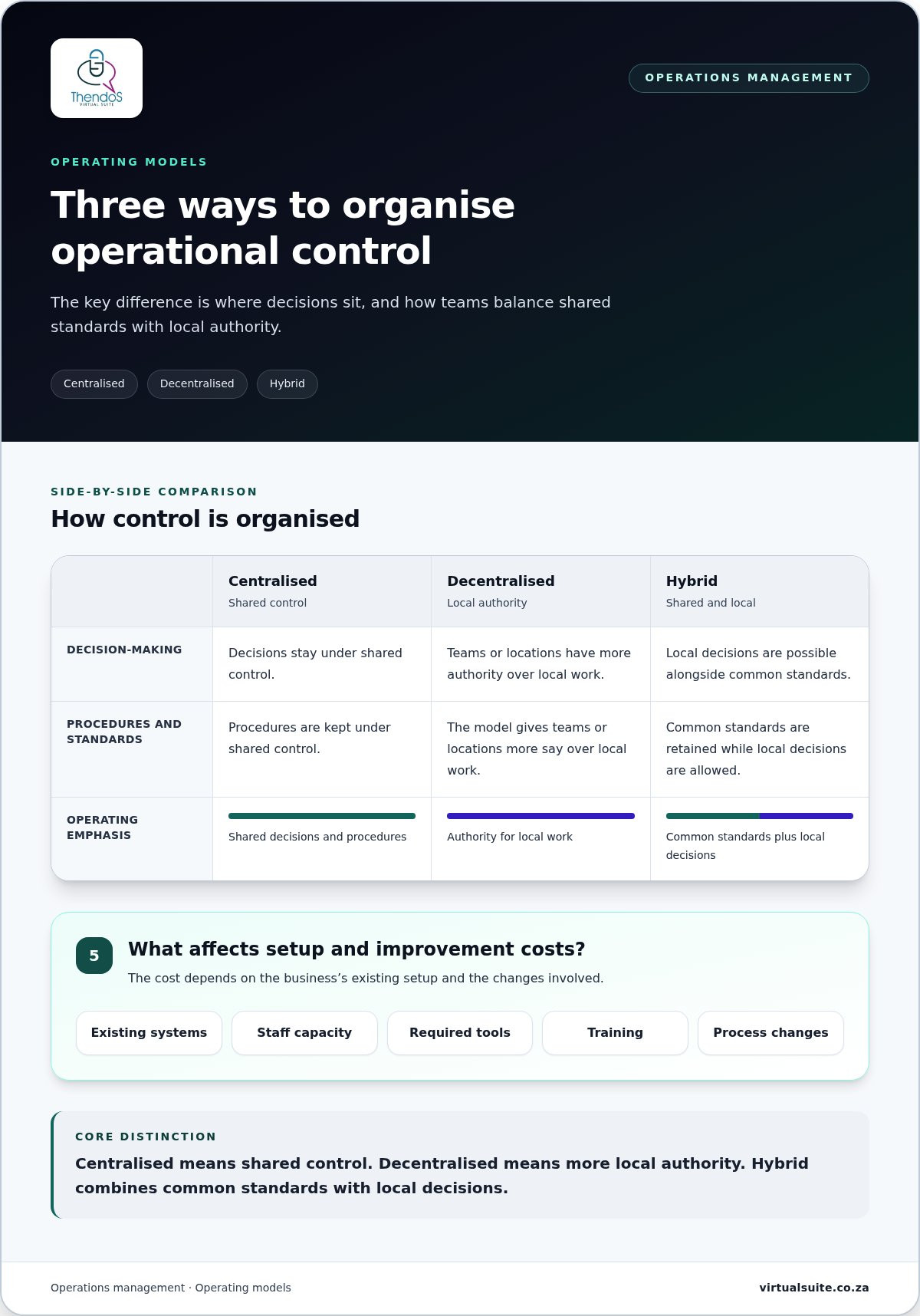
Centralised operations keep decisions and procedures under shared control; decentralised operations give teams or locations more authority over local work. A hybrid approach can retain common standards while allowing local decisions. Setup and improvement costs depend on existing systems, staff capacity, required tools, training and process changes.
Communication, analysis and resource management skills
Clear communication connects daily activities with business priorities. A team member handling customer requests, for example, needs to know who resolves complex issues and how updates reach customers. Written handovers, shared task records and regular team discussions reduce confusion between departments. These habits support reliable work and help everyone understand their responsibilities.
Department responsibilities should identify an owner, expected outcome and resources for each activity. In a growing business, sales may record a customer request, operations may schedule delivery, and finance may issue the invoice. Agreeing how information passes between these roles prevents missed handovers. Managers can then see where decisions belong and where one team depends on another.
Analysis helps leaders distinguish a recurring problem from an isolated delay. Review completion records, customer feedback and employee observations together. If work repeatedly waits for approval, identify who must decide and whether the request needs that level of review. This evidence supports practical changes instead of assumptions about individual performance, and helps teams assess whether a change has improved the process.
Resource allocation means matching people, time, funds and technology to operational priorities. List essential activities, deadlines and available capacity, then assign ownership according to skills and workload. If customer support demand rises, managers can review task distribution before adding responsibilities to an already full schedule. Prioritisation should also account for work that protects service quality and ongoing delivery.
Human resources management includes recruitment, training, development, performance management and employee satisfaction. For example, a new starter needs role-specific guidance, clear procedures and a way to raise questions. Managers should make time for feedback and development, while monitoring whether people have the tools and support their responsibilities require. Where coordinating projects needs clearer ownership, project management support can help organise tasks, responsibilities and progress.
Setting goals and tracking performance metrics
A business strategy turns the organisation’s direction into objectives that guide daily decisions. Start by identifying what needs to improve, such as delivery reliability or customer support, then assign responsibility for the outcome. Department objectives should support the main business objective, so teams work towards a shared result rather than competing priorities.
Make each objective specific, measurable, attainable, realistic and timely. For example, a service business might aim to reduce unanswered customer requests by reviewing response times over an agreed period. State the measure, the person responsible and the review date. This helps employees understand progress and raise barriers early.
Choose performance metrics that reflect the work being managed. A product business might monitor order fulfilment time, inventory turnover, operating costs and error rates. A service team could track customer satisfaction and customer-support response time. Review the figures alongside customer feedback: a faster process is not successful if service quality declines.
Set a regular review rhythm, such as a weekly check of outstanding work and a monthly review of wider objectives. Compare actual results with the intended milestone, identify the cause of any gap, then agree a practical response. If delays persist, examine handovers or workload before changing the target. Ultimately, each review should inform a decision, not simply produce a report.
Working hours and boundaries also shape performance. A new founder could begin with a schedule of five days a week, from 8 a.m. to 6 p.m., then adjust around customer demand and essential activities. Protect time for focused work, breaks and personal commitments. Set clear availability for meetings and customer responses, and review workload when out-of-hours tasks become routine. These boundaries help make the operating plan sustainable.
Operations management definition and scope
Operations management coordinates the ongoing work that turns a business’s resources into goods or services. For leaders considering how to organise business operations, its scope includes the connected decisions behind delivery, from capacity and quality to customer communication. A South African retailer, for example, must align purchasing, stock availability, order handling and staff responsibilities. Viewing these elements together can reveal dependencies that separate departments may overlook.
An operations strategy balances cost, quality, speed, flexibility and innovation against business goals. A furniture maker might streamline sourcing and production to control costs while maintaining the finish customers expect. A service firm may prioritise responsive communication and flexible scheduling instead. The right balance depends on customer expectations, the business model and the capabilities available for consistent delivery.
Operations management covers recurring work, while project management organises initiatives with defined outcomes and timelines. Processing orders is an ongoing operational activity; introducing a new booking system is a project. Distinguishing between them helps leaders set appropriate ownership and review methods. Routine work needs consistent oversight, whereas a project needs clear deliverables, milestones and coordination among the people involved.
A useful test for how to organise business operations is to trace a customer need across the whole organisation. A consultancy might connect an enquiry with an agreed scope, a scheduled service, progress updates and invoicing. At each handover, identify what information must pass forward and who is responsible for receiving it. This makes gaps visible before they affect the customer experience.
An operations roadmap links sales and marketing, service delivery, administration and risk management. Reviewing these connections helps leaders decide which improvement matters most and how teams can maintain continuity as demand changes. Where recurring work needs clearer coordination, support for organising business operations can help bring the moving parts into alignment.
Thendo’s Virtual Suite: Virtual assistant support
Thendo’s Virtual Suite provides virtual assistant and structured operational support for founders and busy professionals who need help keeping routine work organised. This can help when administration, customer records or project coordination take attention away from core responsibilities.
Support can include CRM Management to keep customer information organised, or Project Coordination to manage tasks and progress. The right focus depends on where work is becoming difficult to manage. For example, recurring operational tasks may benefit from clearer coordination, while a project may need closer oversight of responsibilities and next steps.
If you’re ready to discuss operational support, visit virtualsuite.co.za.
Make your next operational improvement deliberate
Choose one recurring friction point and make it the focus of your next review. It might be an unclear handover, competing priorities or a task that repeatedly interrupts planned work. Describe the change you want, decide how you’ll recognise progress, and give the team space to share what works in practice. This keeps improvement connected to real conditions rather than adding process for its own sake.
Learning how to organise business operations is an ongoing leadership practice, not a one-off exercise. As customer needs and workloads shift, revisit whether your routines still support the way the business works. A fresh perspective can help you decide what to prioritise and where better coordination would ease pressure.
If you’d like to explore support for your next operational step, contact Thendo’s Virtual Suite. Steady, considered changes can help you build a more workable path forward.
Frequently Asked Questions
How do you implement a lean workflow?
Implement a lean workflow by following one task from its starting point to the result the customer needs. Mark each handover and approval, then ask whether it prevents an error or adds value. Test a simpler route with the people doing the work, including how exceptions will be handled. Keep changes that improve flow without reducing accuracy or service quality.
What are business operations?
Business operations are the connected activities that keep an organisation functioning and serving customers. In a South African consultancy, they might include handling an enquiry, agreeing the work, scheduling delivery, communicating updates and issuing an invoice. They include customer-facing work and the supporting administration behind it. Looking at the whole chain can reveal dependencies missed when teams consider their tasks separately.
What are the key functions and processes to organise business operations?
Organise the functions that move work from customer need to completed service or delivered product. A useful starting point is to group activities under customer acquisition, delivery, customer support, finance and administration. For each group, identify the information it receives, the result it must produce and who relies on that result next. This shows where responsibilities overlap or a handover lacks a clear owner.
How do you map and document business workflows step by step?
Choose one recurring task, such as responding to a new service enquiry, and map its actual sequence with the people involved. Record what starts the task, each action, the decision points, handovers and the final record or outcome. Check the map against a real example, then document the agreed method and exception route. This makes the workflow useful for training and later review.
How should a small business structure roles, responsibilities and reporting lines?
Structure roles around the work that must be owned, not elaborate titles. For each recurring responsibility, name one accountable person, note who contributes and show who handles decisions outside that person’s authority. A small business owner might retain oversight of client commitments while delegating routine scheduling. Clear reporting lines help staff raise concerns promptly without sending every decision back to the owner.
How do you set operational goals, KPIs and performance dashboards?
Start with an operational outcome, then choose a KPI that signals progress towards it. For example, if the aim is more dependable delivery, track fulfilment time alongside errors or customer feedback, so speed is not considered in isolation. Give each measure an owner, a review rhythm and a defined response when results change. A dashboard should support decisions, not simply display figures without context.

Article by
Thendo Sadiki
CEO of Virtual Suite